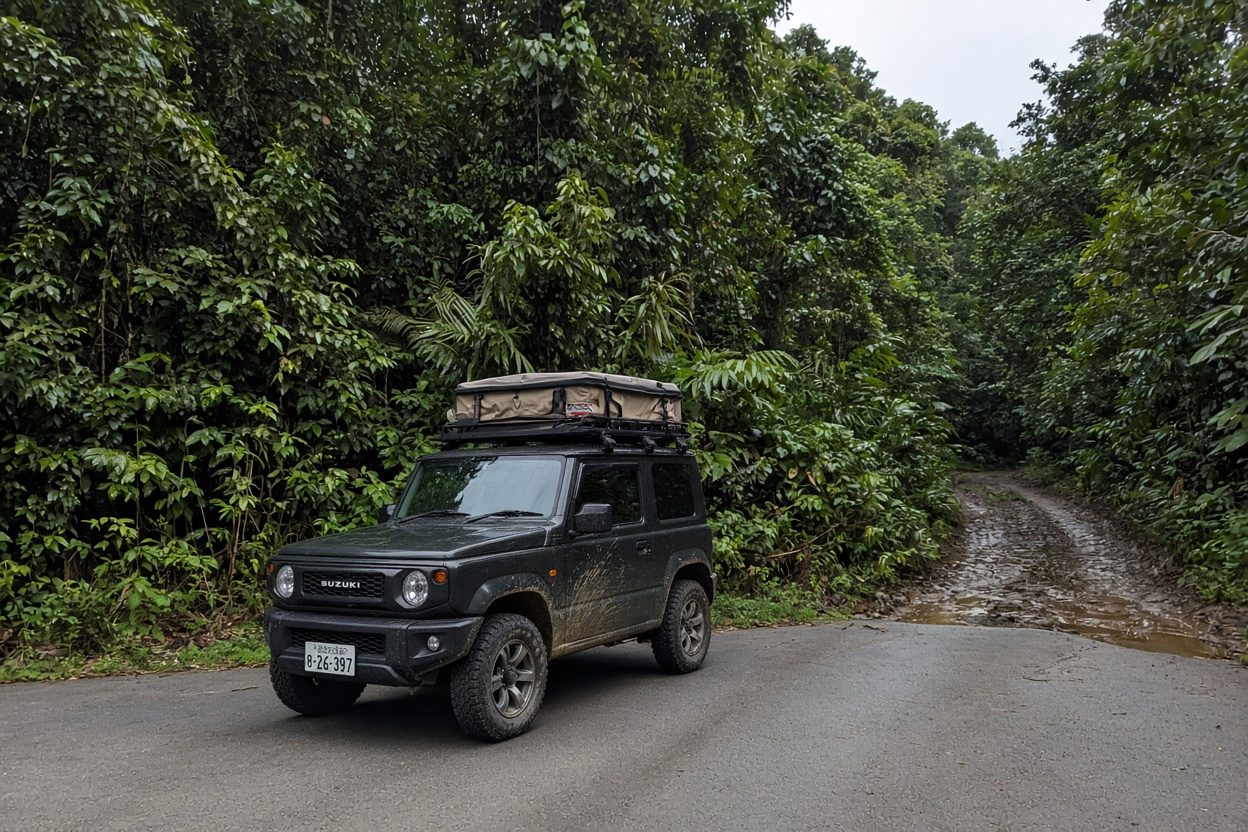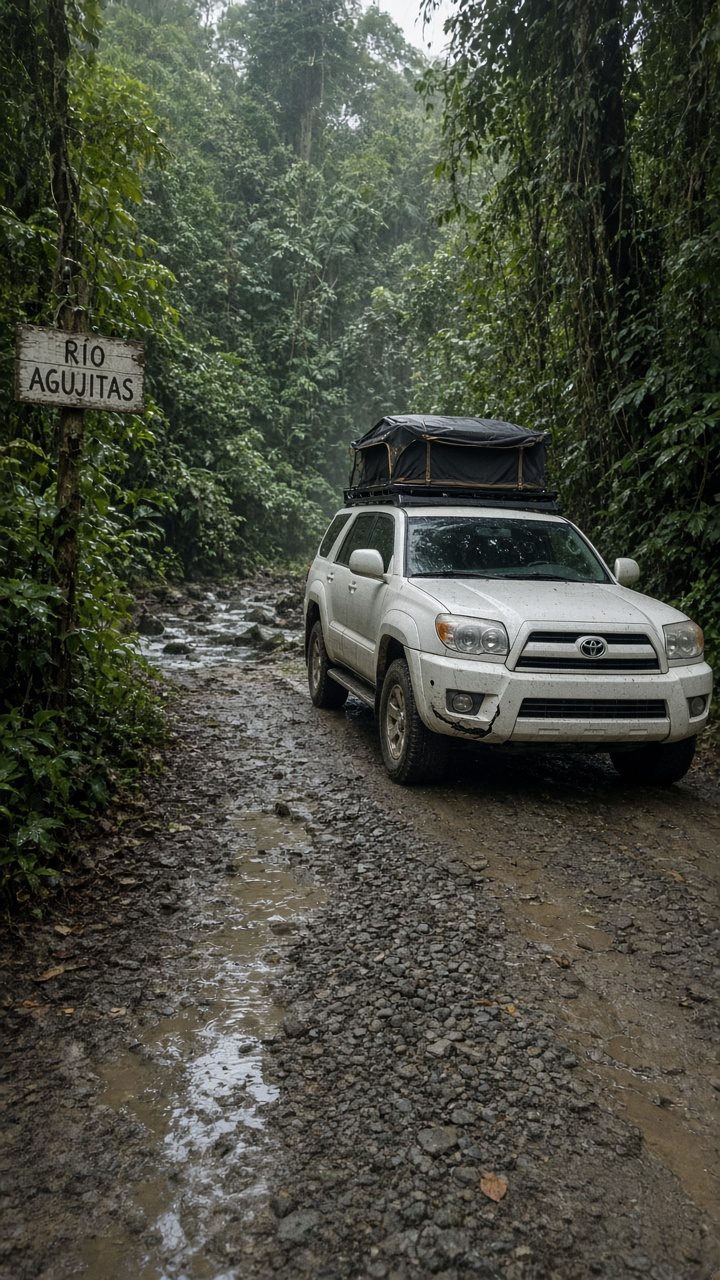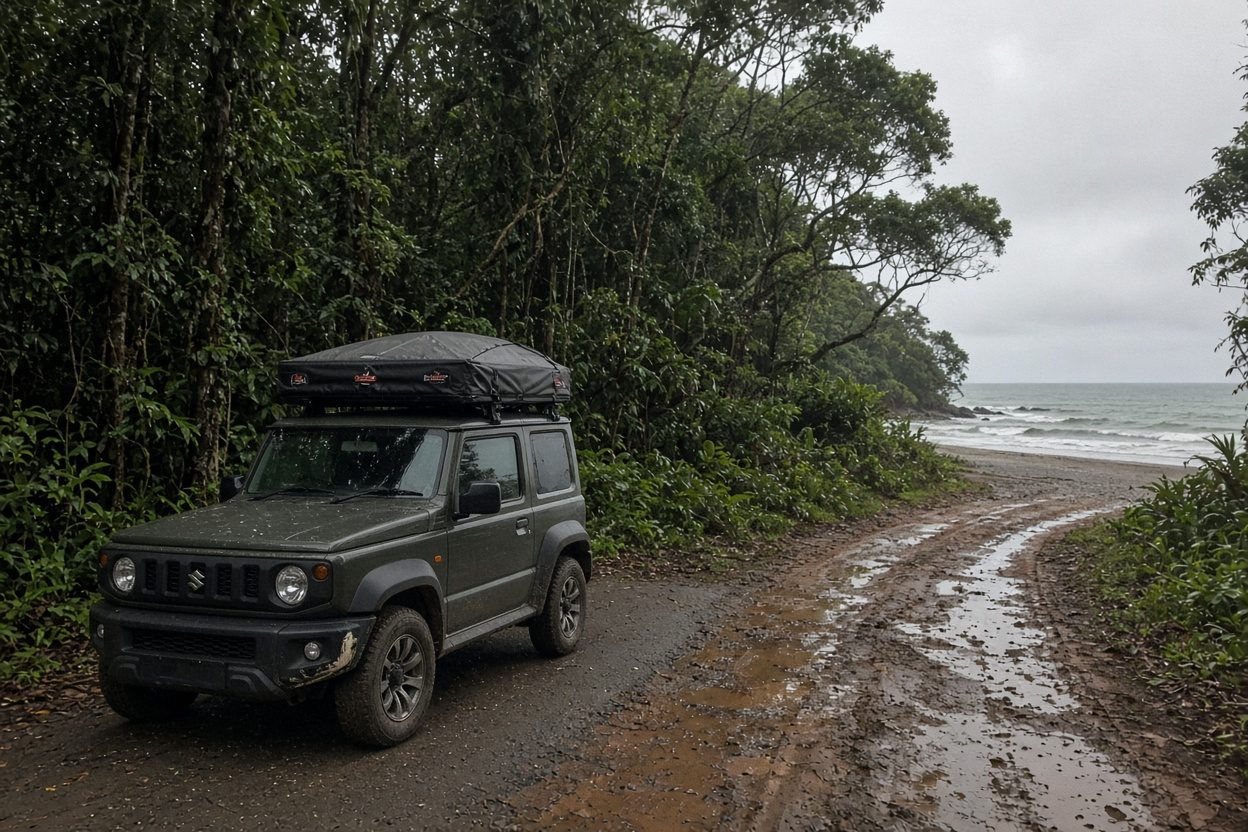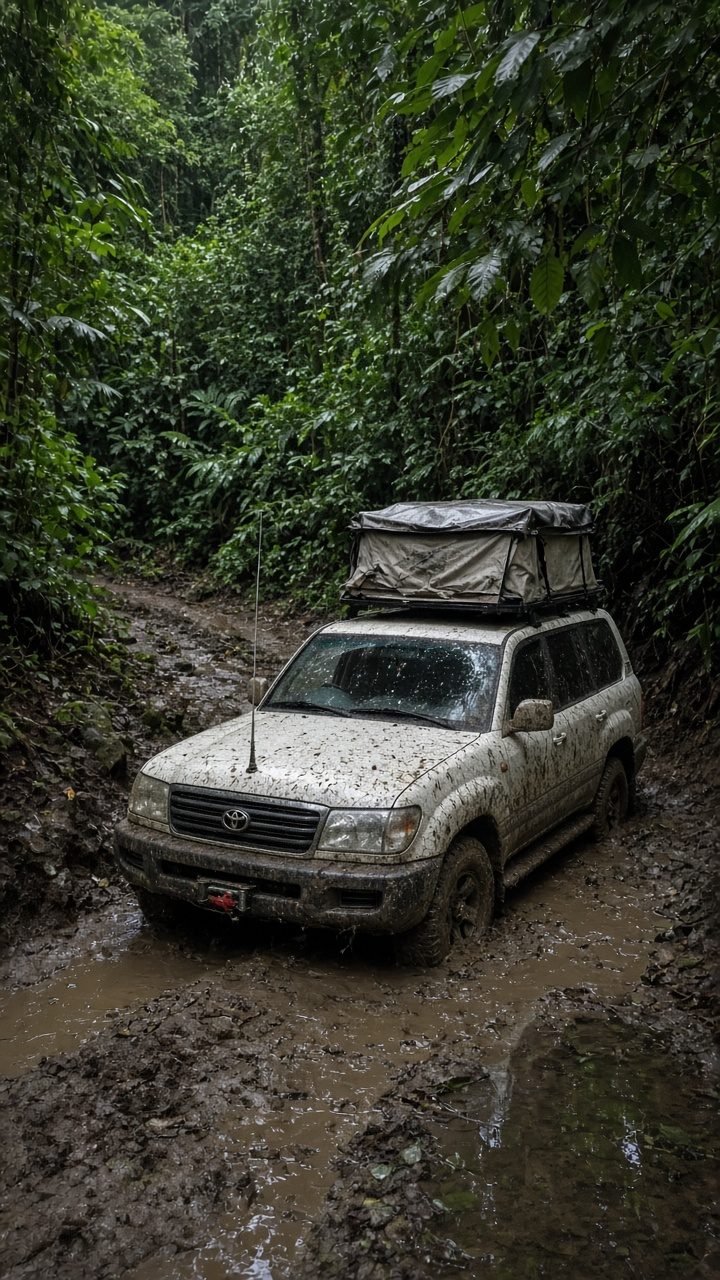
This is the trip for people who read "4x4 recommended" as a suggestion and "road impassable in rain" as a challenge. Eighteen days, a Land Cruiser with a rooftop tent, and a route that strings together the country's genuinely difficult driving: the tide-dependent beach track to Witch's Rock, the backcountry flanks of a live volcano, the no-signal turquoise river, and — the crux — the unbridged, tide-gated fords of the Osa Peninsula out to Carate and the edge of Corcovado.
The name is literal. There is a line on the calendar — the start of the rains, usually May — beyond which large sections of this route become genuinely dangerous or simply undrivable. Rivers that you ford at ankle depth in February run truck-swallowing in June. Run this Dec–Apr, full stop. Even in the dry season, you carry recovery gear, extra fuel, a tide table, and a satellite messenger, because for days at a time you will be beyond cell coverage and beyond any tow truck.
This is not a scenery-checklist trip; it's a competence trip. You'll provision in real towns, sleep in the tent on the roof, read tide charts like a captain, and earn every one of the country's wildest camps. If that's the point, read on.
Day-by-Day
Days 1–3 — Santa Rosa & Witch's Rock (dry-forest overland)
Drive: LIR → Santa Rosa NP HQ/La Casona, ~55 km / ~1 hr paved, then the 🔴 4x4-only track down to Playa Naranjo (Roca Bruja / Witch's Rock) — roughly 12 km of rough road that requires a tough, high-clearance 4x4 and includes a seasonal river crossing that can be impassable even in the dry season (verify at the ranger station before committing). Camp at the SINAC beach campground at Naranjo (reserve with the Santa Rosa sector of ACG/SINAC in advance). Iconic surf, dry-forest wildlife, and howler-monkey dawns.
Days 4–5 — Rincón de la Vieja backcountry
Drive: back to pavement, then to the Rincón sector, ~2–2.5 hrs. Hike the Las Pailas loop (bubbling mud pots, fumaroles) and soak at the Río Negro hot springs. The access roads off the highway are graded gravel — easy for your rig, but dusty. Camp or lodge near Curubandé/Guachipelín.
Days 6–7 — Río Celeste / Tenorio
Drive: to Bijagua, ~2.5–3 hrs, mostly paved with a gravel park approach. Hike Tenorio Volcano NP to the turquoise Río Celeste waterfall and the teñideros where two rivers turn blue. ⚠️ No cell signal in the park; SINAC entry ticket required (buy ahead); the waterfall-base staircase was reported closed mid-2025 — verify locally before you go. Camp around Bijagua.
Days 8–9 — Bajos del Toro
Drive: cross toward the Central Valley highlands to Bajos del Toro, ~3–4 hrs on winding paved-to-gravel mountain roads (daylight only; fog). Hike Catarata del Toro and the Blue Falls / Las Gemelas private trails. Cool, misty camping.
Days 10–13 — Osa: Puerto Jiménez → Matapalo → Carate (the crux)
Drive: the long haul south to the Osa Peninsula — plan a full transit day down the Costanera/Interamericana to Puerto Jiménez (~7–8 hrs from the highlands; this is your last fuel, cash/ATM, and full provisioning — there is none beyond). From Pto Jiménez, the coastal track to Cabo Matapalo (~1.5 hrs, 4x4) and on to Carate at the end of the road involves multiple river fords that must be crossed at low tide 🔴. Time your moves to the tide chart, not the clock. Camp at Matapalo and Carate (confirm private-land permission; Carate has an airstrip and a pulpería, nothing more).
Days 14–16 — Corcovado (guided)
From Carate, hike the La Leona sector into Corcovado National Park. ⚠️ A SINAC entry permit (about $18/person/day) AND a certified ICT-registered guide are MANDATORY — you cannot enter independently. Overnight stays at the Sirena ranger station require accommodation permits booked well in advance; meals there are limited. Arrange the permit + guide + bunkhouse package before the trip. Wildlife here is the densest in Costa Rica: tapir, four monkey species, scarlet macaws, and jaguar sign.
Days 17–18 — Exit via San Isidro
Drive: back-track off the peninsula (mind the tide on the return fords), then climb to San Isidro de El General and out — ~5–6 hrs of highway. Decompress, refuel, and hand the rig back clean of Osa mud.
Signature Stops (Why Go)
- Playa Naranjo / Witch's Rock — a legendary surf beach you can only drive to with a real 4x4 and the right tide.
- Río Celeste — a river that turns Windex-blue where two streams meet.
- The Osa fords — the badge crossing: tide-gated, unbridged, and unforgettable.
- Corcovado (La Leona/Sirena) — the last great lowland rainforest, on foot with a guide.
Where to Camp / Stay (Named)
- Santa Rosa NP — Playa Naranjo campground (SINAC/ACG reservation).
- Rincón de la Vieja — Guachipelín/Curubandé lodges or camping.
- Bijagua camps for Río Celeste.
- Bajos del Toro highland camps.
- Matapalo & Carate rooftop-tent camps (private-land permission).
- Sirena ranger station bunkhouse inside Corcovado (permit-gated, book far ahead).
Logistics & Road Reality
- 🔴 Season is a hard gate: Dec–Apr only. In the rains the Naranjo track and the Osa fords are impassable.
- Fuel & cash: Puerto Jiménez is the last fuel, ATM, and grocery before Matapalo/Carate. Carry jerry cans. Drake Bay and Carate have no gas and no ATM.
- Tides rule the Osa: cross the fords at low tide; buffer a day for tide timing on the way in and out. Carry a printed tide table — no signal to check one.
- Corcovado: permit + certified guide mandatory; Sirena overnight requires advance accommodation permits. No walk-ins.
- Comms: carry a satellite messenger. Río Celeste and much of the Osa have zero cell coverage.
- Recovery: winch, traction boards, tow strap, and a partner vehicle mindset — you are your own tow truck out here.
Insider Tips
- Verify the Naranjo river crossing at the Santa Rosa ranger station the morning of — it swings between drivable and impassable with a single upstream rain.
- Provision for the whole Osa leg in Puerto Jiménez. Assume nothing is available past it — food, water, fuel, cash.
- Book Corcovado's Sirena package months ahead. Guide + entry permit + bunkhouse sell out; there is no last-minute option for an overnight traverse.
- Drive the Osa fords on a falling-to-low tide, never a rising one. Getting stranded mid-crossing on an incoming tide is the classic Osa disaster.
- Confirm the Río Celeste base staircase status (reported closed mid-2025) so you know before you pay the SINAC entry.
Reserve Your Rig
The Mud Line is a Land Cruiser + rooftop-tent expedition — the only tier that survives the Naranjo track and the Osa fords. VerifiedCR outfits with recovery gear, jerry cans, and a satellite-messenger loan, and can help coordinate the tide consult, GPX pack, and Corcovado permit/guide booking that this route requires. Reserve early for the Dec–Apr window. [Reserve your VerifiedCR Land Cruiser →]
Before you go
Do you need a 4x4?
seasonal river ford — 4x4 advised
Best window to fly
Dec–Apr ONLY (wet-season fords and tracks turn impassable)
Offline first
Download your route and offline maps before you leave the lot — signal drops on the best stretches.
Golden rule
Never drive at night — plan arrivals before dark, and use Waze like the locals do.
VerifiedCR · No counter surprises
What a Costa Rica rental actually costs
The number one thing that rattles first-timers is the price jumping at the counter. Here is the honest math, before you get there.
- Advertised daily rate$12–40 / day
- What the booking sites show. It is real — but it is not the whole price. Nobody pays only this.
- Mandatory liability (TPL / SLI)+$15–25 / day
- Required by Costa Rican law on every rental. Cannot be waived. This is the line the cheap ads leave off — it roughly doubles the sticker price. Budget for it.
- Collision damage (CDW)waivable
- Often $20–40/day — but you can usually decline it if your credit card includes rental coverage (Amex, Visa Signature, Chase Sapphire and others). Call your card, ask for a coverage letter, and bring it printed.
- Security hold on your card$1,000–2,500
- A hold, not a charge — released after you return the car clean. Some agencies hold more. Make sure your card has the headroom before you fly.
The verified-rig promise: when you reserve through VerifiedCR, the rig is inspection-checked and the operator is vetted — the price you are quoted is the price you pay. No mystery line items at pickup.