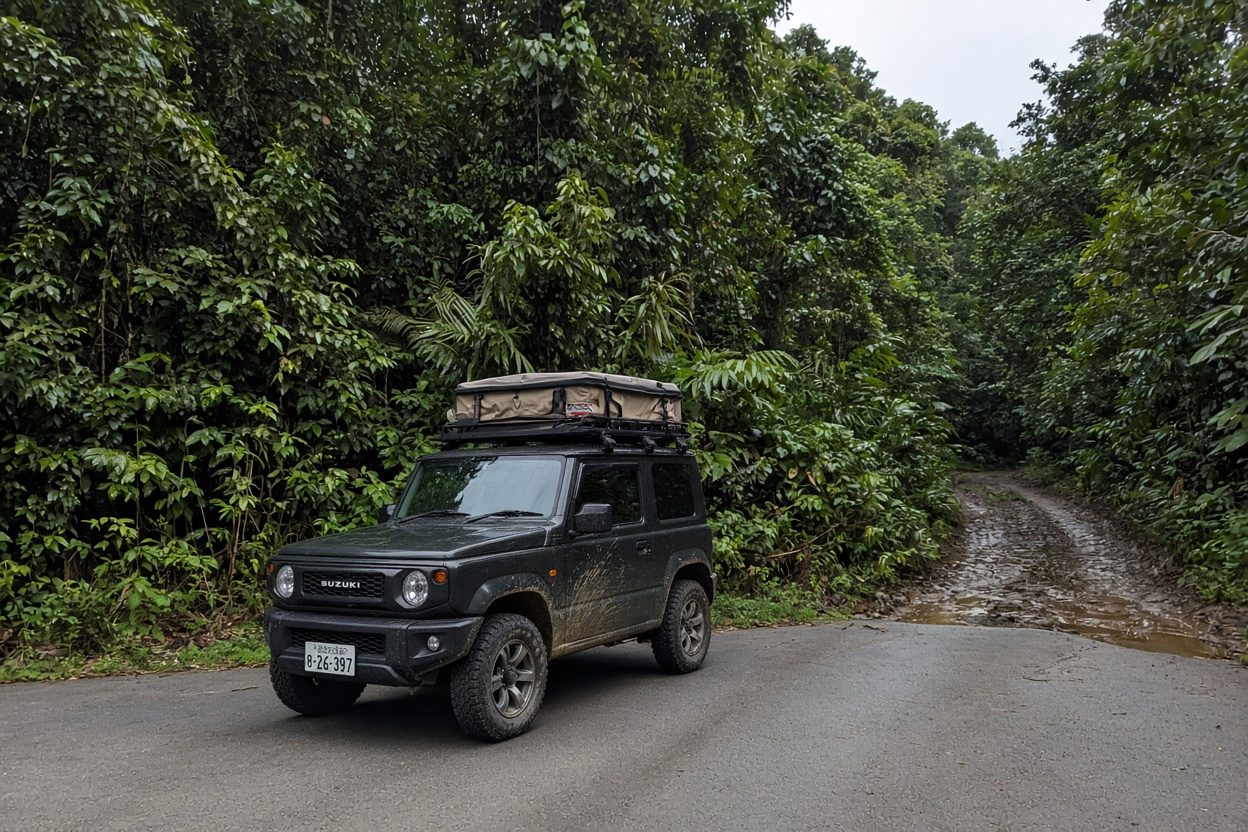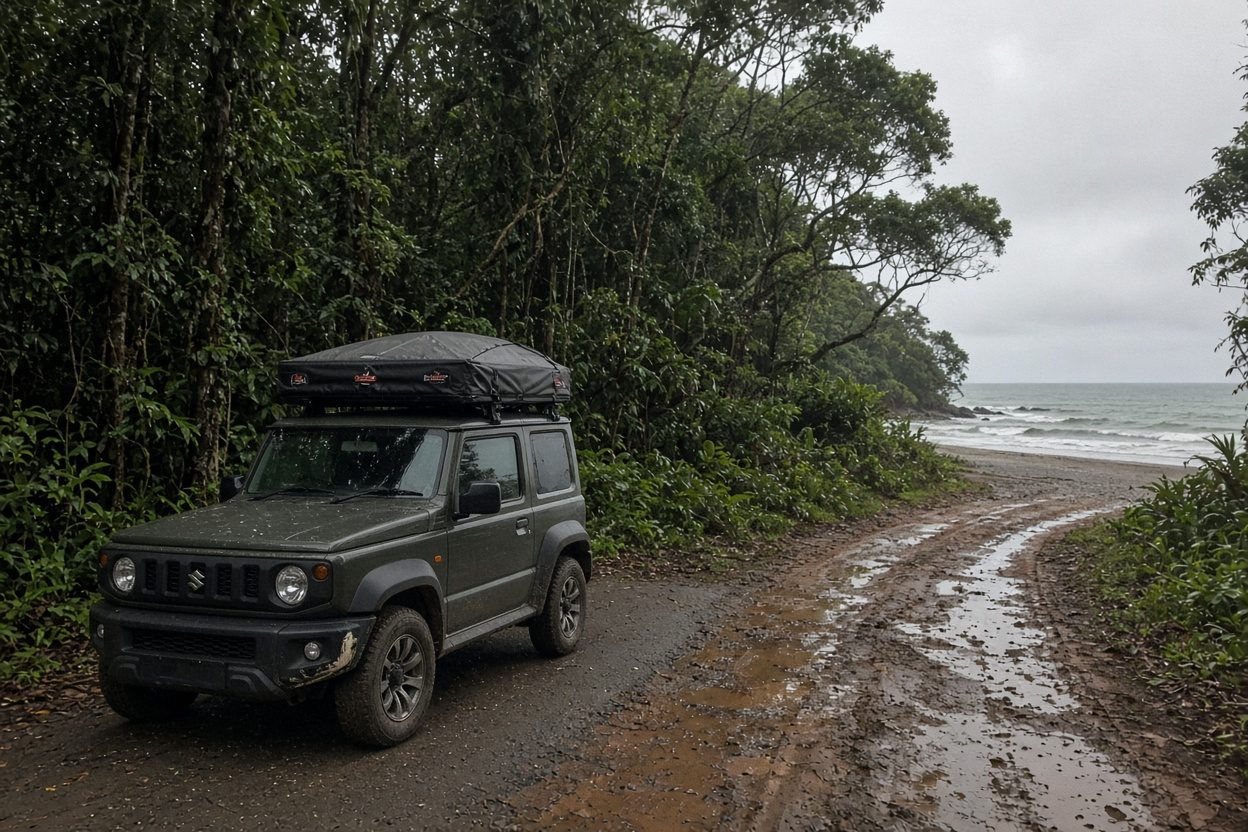
Some corners of the Osa demand a Land Cruiser and a tide table. This one just asks you to show up in the right month. Uvita, on the northern edge of the Deep South Pacific, is home to one of Costa Rica's most photographed natural features: the Whale's Tail — a sandbar tombolo inside Marino Ballena National Park that, at low tide, emerges from the sea in the perfect shape of a whale's fluke. You can literally walk out onto the tail. And the symbolism isn't accidental: Marino Ballena is the country's premier humpback-whale sanctuary, hosting one of the longest humpback seasons on the planet.
We rank this run 🟢 — it's easy. The roads are paved, the activities are gentle, and a compact 4x4 is all you need. What makes or breaks the trip isn't terrain; it's timing two calendars at once: the tide (which decides whether the sandbar is walkable) and the season (which decides whether the whales are in town). Humpbacks migrate to Marino Ballena in two windows — roughly July to October (southern-hemisphere whales) and December to April (northern-hemisphere whales) — so you can catch them in either the green or dry season. This is the ideal first taste of the South Pacific for families and newcomers.
Day-by-Day
Day 1 — Uvita and the Whale's Tail at low tide. Arrive in Uvita, check in, and head straight for the tide chart, because your first mission is walking the tombolo. When the tide drops, the sandbar rises above the waterline and you can stroll out toward the tip of the "tail," with the national park's beaches curving away on both sides. It's a magical, easy walk — but it's only possible at low tide, so plan your afternoon around the water, not your watch. Pay the modest Marino Ballena park entry, bring reef-safe sunscreen, and time your walk-out for the hour or so around low water so you're not caught by the returning sea.
Day 2 — Humpback and dolphin boat; Marino Ballena. The main event: a morning whale-and-dolphin boat tour out of Uvita. In season, humpbacks breach and tail-slap within sight of the boat, and spotted and bottlenose dolphins are near-daily companions. Even outside peak whale weeks, the marine park delivers dolphins, seabirds, and the dramatic rock formations off the tail. Spend the afternoon on the park's beaches — Playa Uvita, Playa Colonia, Playa Hermosa — which are broad, calm, and family-friendly.
Day 3 — Catarata Uvita, then out. Before you leave, hit the Catarata Uvita, a short, easy waterfall right in town with a natural slide and a swimming pool at the base — a fun, cooling finale, especially with kids. It's a quick visit, leaving the afternoon for the drive onward.
Signature Stops (why go)
- The Whale's Tail (tombolo) at low tide — walk out onto a sandbar shaped like a whale's fluke inside Marino Ballena; unmissable and genuinely unique.
- Marino Ballena National Park — Costa Rica's flagship humpback sanctuary, with two long whale seasons and reliable dolphins.
- Catarata Uvita — an easy in-town waterfall with a natural slide and swimming hole.
Where to Stay
Uvita is well set up for every budget: cabinas, guesthouses, campgrounds, and small hotels cluster near the park entrance and along the main road. Because this is a developed, road-accessible town, ATMs, fuel, groceries, and card acceptance are all easy — no deep-Osa cash anxiety here. Campgrounds near the beach entrance are a great value for families with a rooftop tent or gear.
Logistics & Road Reality
- Easy, paved access: The Costanera Sur highway runs right through Uvita; a compact 4x4 is plenty and 2WD is often fine in the dry.
- Two calendars to match: Time the tide for the Whale's Tail walk and the season for the whales — humpbacks are present ~Jul–Oct and ~Dec–Apr. Both windows work; peak sightings cluster in Aug–Sep and Jan–Mar.
- Park entry & tides: Marino Ballena charges a modest entrance fee; get the day's low-tide time from your lodge or a tide app and plan the sandbar walk around it.
- Services: Full town amenities — ATM, fuel, supermarket. Easiest logistics in the whole zone.
- Connectivity: Good signal throughout; no special prep needed.
- Overland 🟢 vs through-land 🔴: 🟢 — the gateway experience; anyone can do this.
Insider Tips
- Walk the tail 60–90 minutes before dead-low tide. You get the full sandbar with a safety margin and beat the crowd that shows up right at low water.
- Book the whale boat for the morning. Seas are calmer and light is better before the afternoon wind picks up.
- Choose a licensed, whale-responsible operator. Marino Ballena regulates boat distance from whales; a good captain respects it and you still get incredible views.
- Bring water shoes for Catarata Uvita. The rocks around the slide and pool are slick.
- Reef-safe sunscreen only. You're in a marine national park — protect the reef and the tail.
Reserve Your Rig
An easy, joyful introduction to the South Pacific — and an easy rental to match. Reserve a comfortable compact 4x4 with a whale-charter add-on and a printed low-tide timing card, and we'll make sure you're standing on the tail at exactly the right hour. [Reserve your Uvita 4x4 →]
Before you go
Do you need a 4x4?
paved all the way — 2WD ok
Best window to fly
Jul–Oct & Dec–Apr (humpback windows)
Offline first
Download your route and offline maps before you leave the lot — signal drops on the best stretches.
Golden rule
Never drive at night — plan arrivals before dark, and use Waze like the locals do.
VerifiedCR · No counter surprises
What a Costa Rica rental actually costs
The number one thing that rattles first-timers is the price jumping at the counter. Here is the honest math, before you get there.
- Advertised daily rate$12–40 / day
- What the booking sites show. It is real — but it is not the whole price. Nobody pays only this.
- Mandatory liability (TPL / SLI)+$15–25 / day
- Required by Costa Rican law on every rental. Cannot be waived. This is the line the cheap ads leave off — it roughly doubles the sticker price. Budget for it.
- Collision damage (CDW)waivable
- Often $20–40/day — but you can usually decline it if your credit card includes rental coverage (Amex, Visa Signature, Chase Sapphire and others). Call your card, ask for a coverage letter, and bring it printed.
- Security hold on your card$1,000–2,500
- A hold, not a charge — released after you return the car clean. Some agencies hold more. Make sure your card has the headroom before you fly.
The verified-rig promise: when you reserve through VerifiedCR, the rig is inspection-checked and the operator is vetted — the price you are quoted is the price you pay. No mystery line items at pickup.