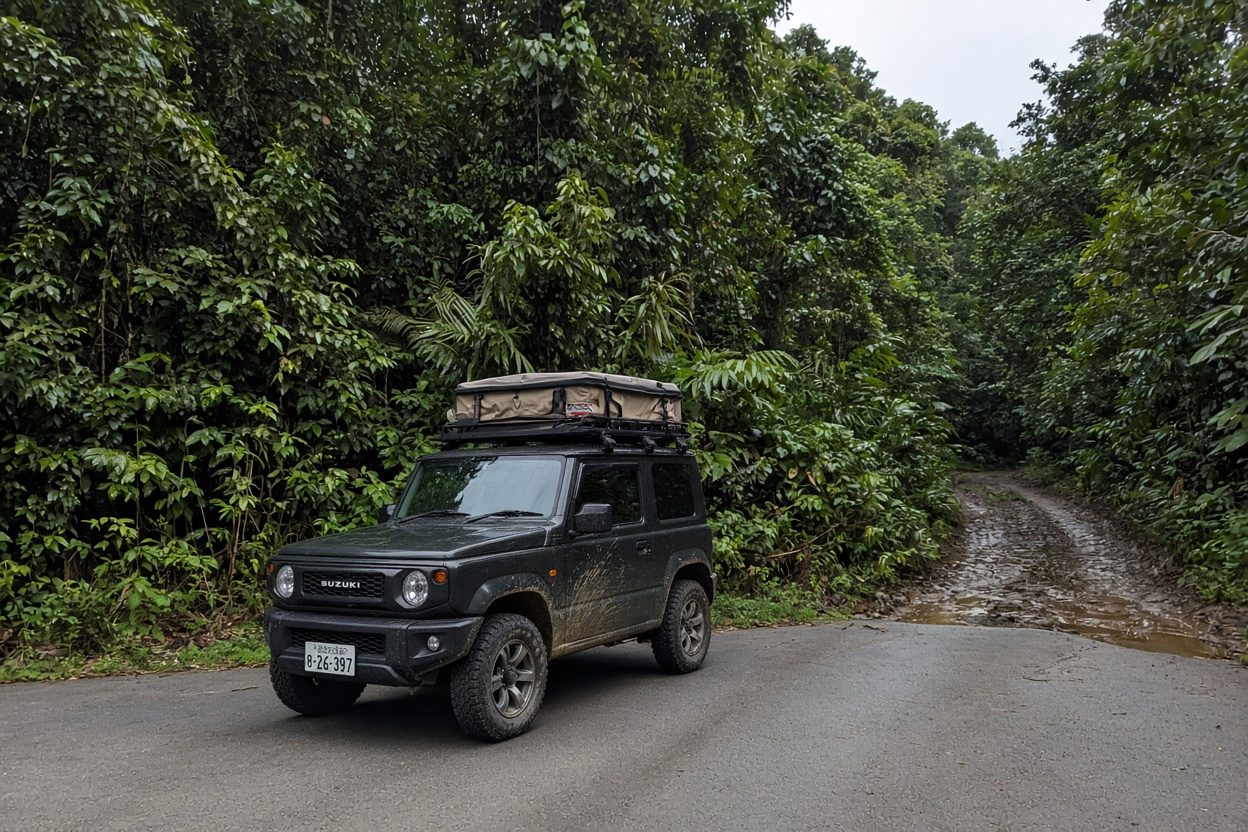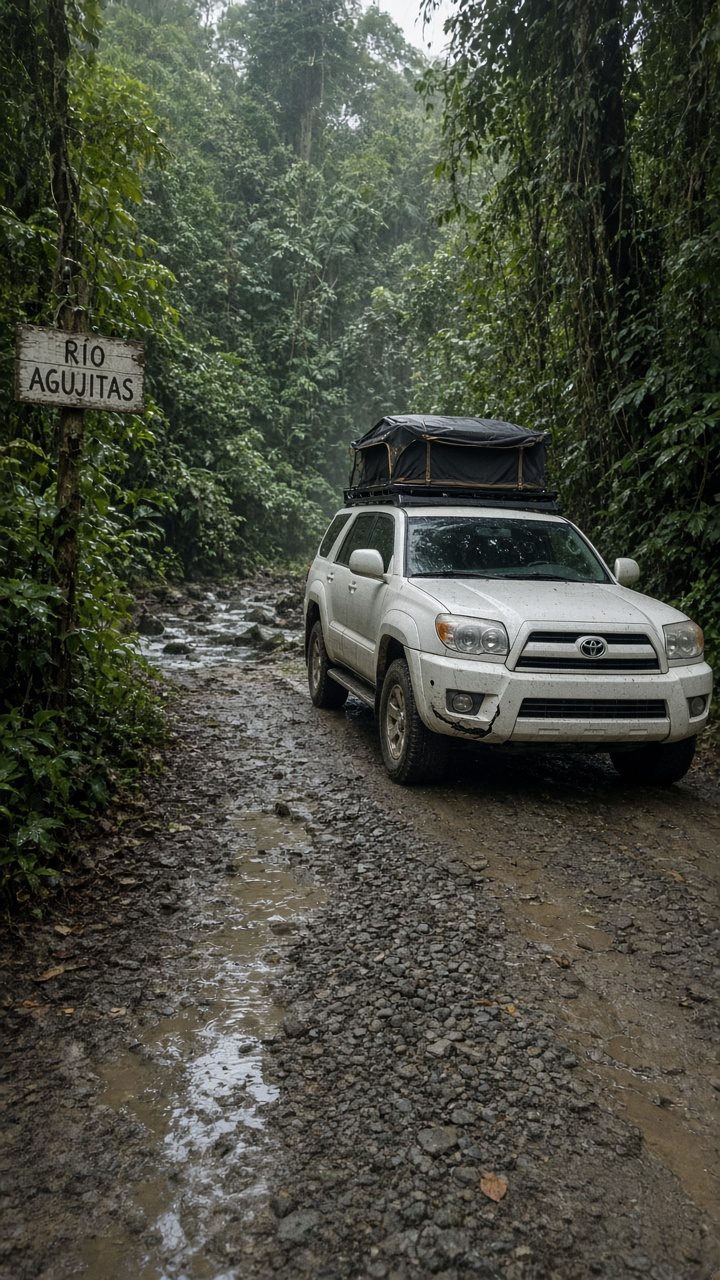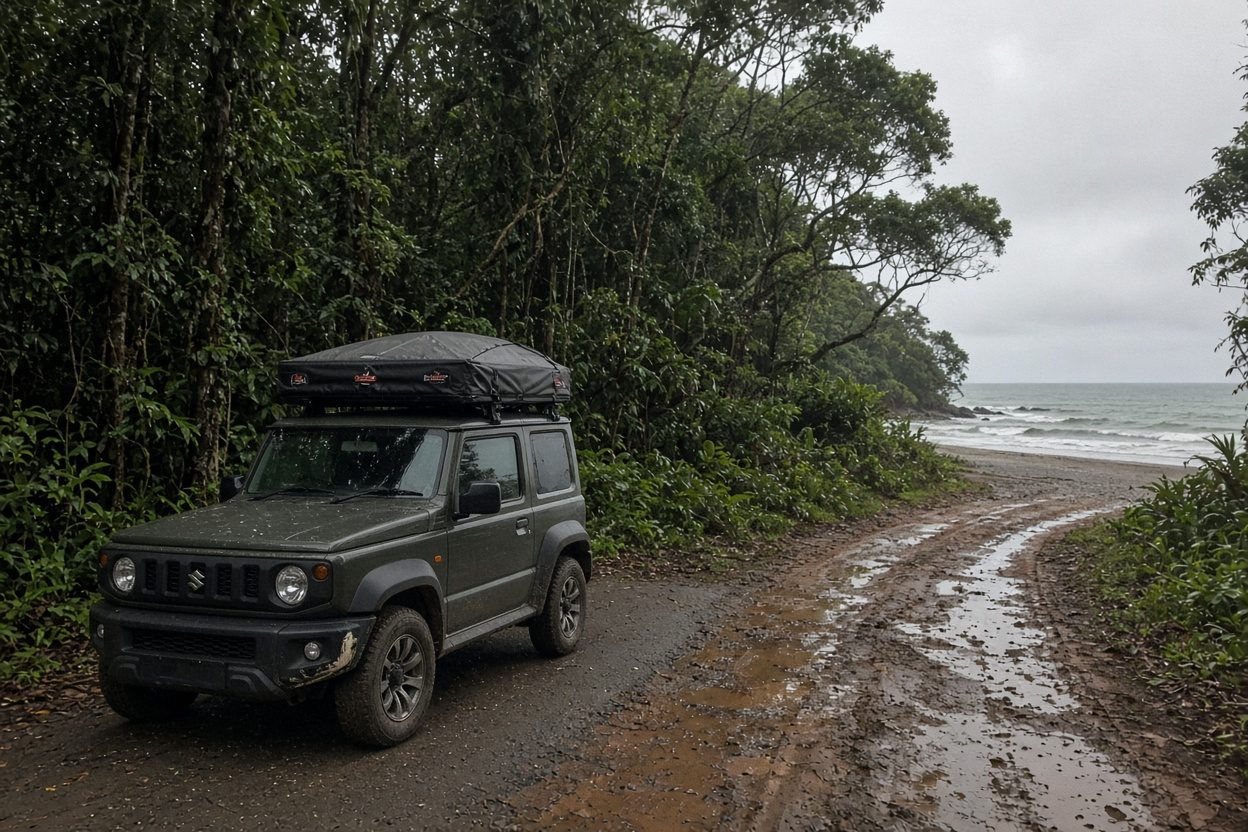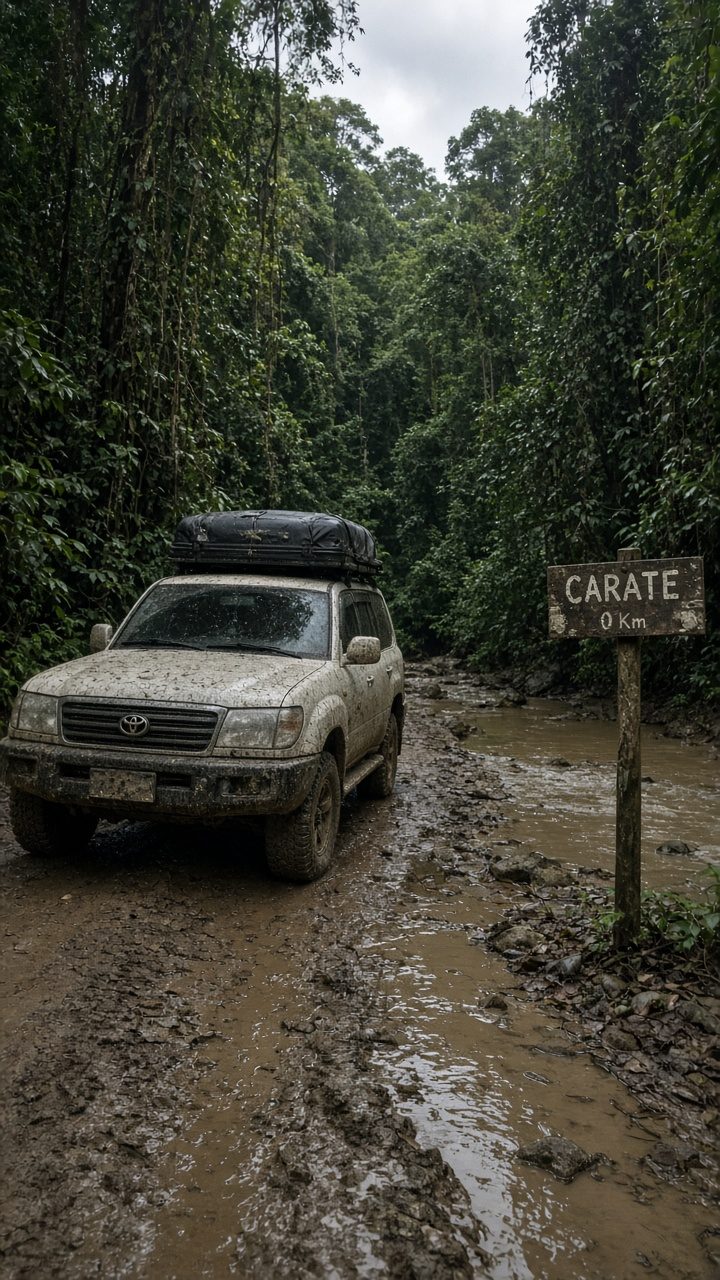
This is the drive that separates people who say they overland from people who do. The coast road southeast of Puerto Jiménez runs to Cabo Matapalo and then keeps going — unpaved, unbridged, and tide-gated — until it simply stops at Carate, where an airstrip and a single pulpería mark the literal end of the road on the Osa Peninsula. Beyond that is Corcovado National Park and the Pacific. There is no loop, no shortcut, and no bailout. You come back the way you came.
We rank this route 🔴 through-land extreme for a reason. It is not a scenic cruise; it is a committing back-and-forth into one of the least-developed corners of Costa Rica, where your fuel, your cash, your water, and your recovery plan all have to leave Puerto Jiménez with you. The reward is a stretch of jungle-meets-ocean that most visitors only ever see from a $200 shuttle: howler-loud rainforest dropping straight onto surf points, scarlet macaws working the beach almonds, and crocodile-holding estuaries you'll ford on a falling tide.
Do it in the dry season (December–April). The rest of the year the rivers rise fast and the clay turns to grease; September through November is the worst of it. This page assumes a Land Cruiser-class rig with a rooftop tent, a winch or recovery gear, and offline maps loaded before you leave pavement — because you will lose signal, and you will need to know which ford is which.
Day-by-Day
Day 1 — Provision hard in Puerto Jiménez. Treat "Pto Jiménez" as your last real town. This is where you top off fuel (the gas station here is your last reliable one before you turn back), pull every colón of cash you'll need, buy water and food for five days, and — critically — get a current tide table. There is no ATM and no fuel at Carate or Matapalo, and card acceptance thins out fast the moment you leave town. Sleep in or near Jiménez; it's a relaxed gulf-side town with cabinas, sodas, and a working supermarket. Use the afternoon to air down, check your spare, and confirm your recovery kit.
Day 2 — Coast road to Cabo Matapalo (~21 km / roughly 1 hr, but plan for more). The road southeast is gravel, potholed, hilly, and studded with small stream crossings. Locals and forums consistently describe it as "horrendous" for the uninitiated — narrow, uneven, with posted tide warnings — but entirely doable in a proper 4x4 with clearance in the dry season. You'll hit your first real fords along here. Cross slow, in low range, on a falling or low tide, and walk anything you can't read. Camp at Matapalo (confirm private-land permission first — most sites here are on private fincas, so ask, don't assume).
Day 3 — Matapalo: surf, jungle, tide-check. Cabo Matapalo is the peninsula's tip, where the Golfo Dulce meets the open Pacific and three world-class points — Pan Dulce, Backwash, and King's Wave — break within paddling distance. Spend the morning surfing or walking the rainforest trails; the King Louis Waterfall (a jungle cascade you can climb and rappel with a local outfitter) is nearby and reachable only by high-clearance 4x4. Use the afternoon to study tomorrow's tides: the push to Carate is the most crossing-dependent leg of the trip, so you plan the departure window around low water, not around your alarm clock.
Day 4 — Push to Carate (~24 km of the roughest road yet). This is the marquee day. The track deteriorates, the estuaries get bigger, and you'll ford several croc-holding river mouths on the way. Go early on the low tide, keep momentum without hammering, and know your exit line before you enter the water. Carate itself is tiny — an airstrip, a pulpería, and the trailhead into Corcovado's La Leona sector. Camp near Carate (again, private-land permission) and walk the beach at dusk; this is prime scarlet-macaw and nesting-turtle country, and the night sky here is genuinely dark.
Day 5 — Back-track with a tide buffer. There is no other way out. Retrace Carate → Matapalo → Puerto Jiménez, and build in a generous tide buffer — if you mistime the estuaries you may sit and wait hours for the water to drop. Aim to be back in Jiménez by mid-afternoon with fuel to spare. Celebrate with a cold one at a gulf-side soda; you've earned the badge.
Signature Stops (why go)
- Cabo Matapalo — the geographic tip of the Osa, where gulf and ocean collide over three serious surf points and primary rainforest tumbles to the sand.
- King Louis Waterfall — a climb-and-rappel jungle cascade above Matapalo, 4x4-only access, best with a local guide.
- Carate — the literal end of the road: airstrip, pulpería, and the La Leona gateway to Corcovado. Standing here, you understand why the Osa is called Costa Rica's last frontier.
- The croc estuaries & Golfo Dulce shoreline — the fords themselves are the attraction; each is a small, honest test.
Where to Camp / Stay
Rooftop-tent camping at Matapalo and Carate is the whole point of this rig — but nearly all viable sites are on private land, so secure permission in advance (ask at Jiménez outfitters or the Carate pulpería). If you want a roof, Puerto Jiménez has cabinas and small hotels for Day 1 and Day 5, and Matapalo has a handful of off-grid eco-lodges if the tent isn't your style. Do not count on booking anything last-minute at Carate.
Logistics & Road Reality
- Fuel & cash: Puerto Jiménez is your last gas and last ATM. Carate and Matapalo have neither. Carry a full tank plus jerry cans and all the cash you'll need in colones.
- 4x4, fords & tides: Land Cruiser-class, low range, real clearance. The Matapalo–Carate stretch has multiple unbridged river crossings that are impassable at high tide — plan every leg around a tide table and never enter water you haven't read on foot.
- Season: Dry season (Dec–Apr) only for the full push. Roads are worst Sept–Nov.
- Connectivity: Expect dead zones past Jiménez. Offline maps (Gaia/OsmAnd) and a downloaded tide table are non-negotiable; a satellite messenger is strongly recommended.
- Safety: Crocodiles inhabit the estuaries — never wade to "test" a deep ford; watch, wait, or turn back. Tell someone your plan and expected return.
- Overland 🟢 vs through-land 🔴: This is 🔴. It's an out-and-back into a cul-de-sac of wilderness, not a through-route — treat it as an expedition.
Insider Tips
- Buy the tide table on paper. Screenshots die with your battery; a printed tide sheet on the dash is how the locals do it.
- Cross on a falling tide, not a rising one. If you misjudge, a falling tide gives you a widening window; a rising tide can trap you on the wrong side.
- Air down before Matapalo. Lower pressure floats you over the loose gravel and soft estuary sand and saves your kidneys.
- Carry more cash than you think. Guides, camping permission, and the Carate pulpería are cash-only, and there's no fallback for 40 km.
- Start every driving day at first light. Cooler engine, better tide windows, and the wildlife — macaws, monkeys, coatis — is most active on the road before the heat.
Reserve Your Rig
This route is the reason the Land Cruiser exists in our fleet. Reserve the expedition-spec rig with rooftop tent, recovery gear, and a tide-and-GPX consult, and we'll load your offline maps and brief you on the current fords before you leave the lot. [Reserve your Land Cruiser →]
Before you go
Do you need a 4x4?
seasonal river ford — 4x4 advised
Best window to fly
Dec–Apr (dry season only)
Offline first
Download your route and offline maps before you leave the lot — signal drops on the best stretches.
Golden rule
Never drive at night — plan arrivals before dark, and use Waze like the locals do.
VerifiedCR · No counter surprises
What a Costa Rica rental actually costs
The number one thing that rattles first-timers is the price jumping at the counter. Here is the honest math, before you get there.
- Advertised daily rate$12–40 / day
- What the booking sites show. It is real — but it is not the whole price. Nobody pays only this.
- Mandatory liability (TPL / SLI)+$15–25 / day
- Required by Costa Rican law on every rental. Cannot be waived. This is the line the cheap ads leave off — it roughly doubles the sticker price. Budget for it.
- Collision damage (CDW)waivable
- Often $20–40/day — but you can usually decline it if your credit card includes rental coverage (Amex, Visa Signature, Chase Sapphire and others). Call your card, ask for a coverage letter, and bring it printed.
- Security hold on your card$1,000–2,500
- A hold, not a charge — released after you return the car clean. Some agencies hold more. Make sure your card has the headroom before you fly.
The verified-rig promise: when you reserve through VerifiedCR, the rig is inspection-checked and the operator is vetted — the price you are quoted is the price you pay. No mystery line items at pickup.