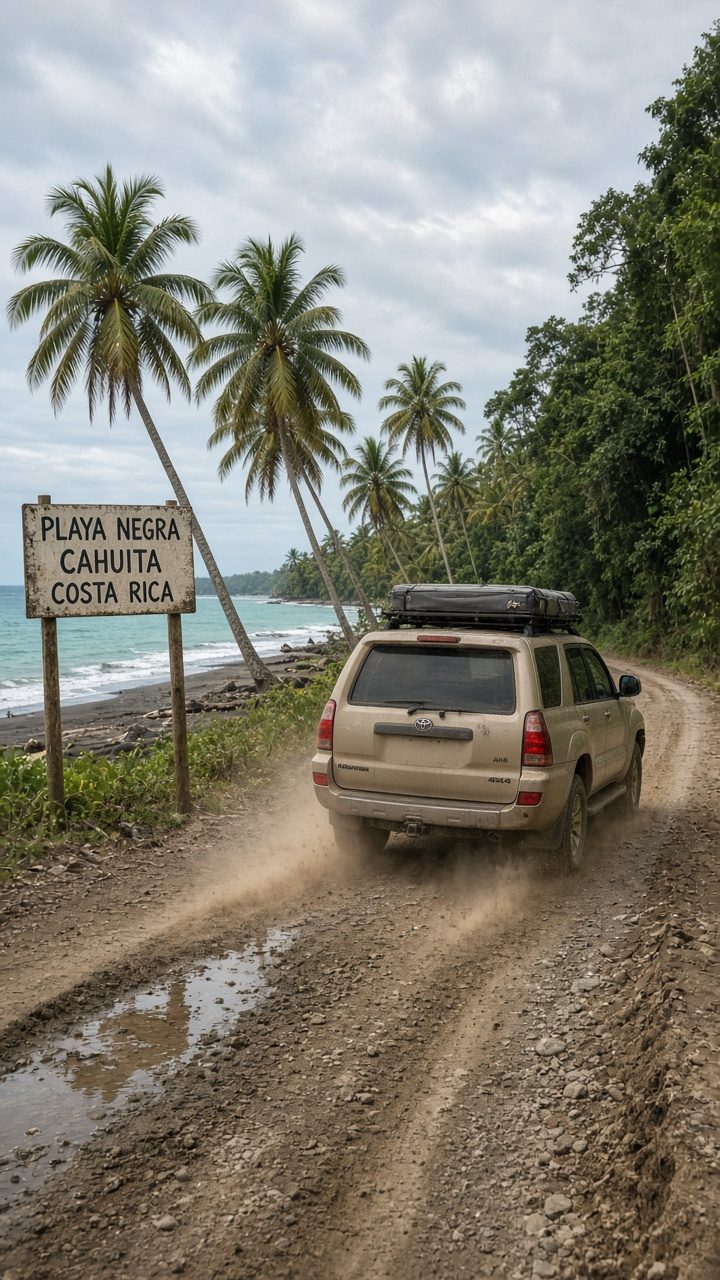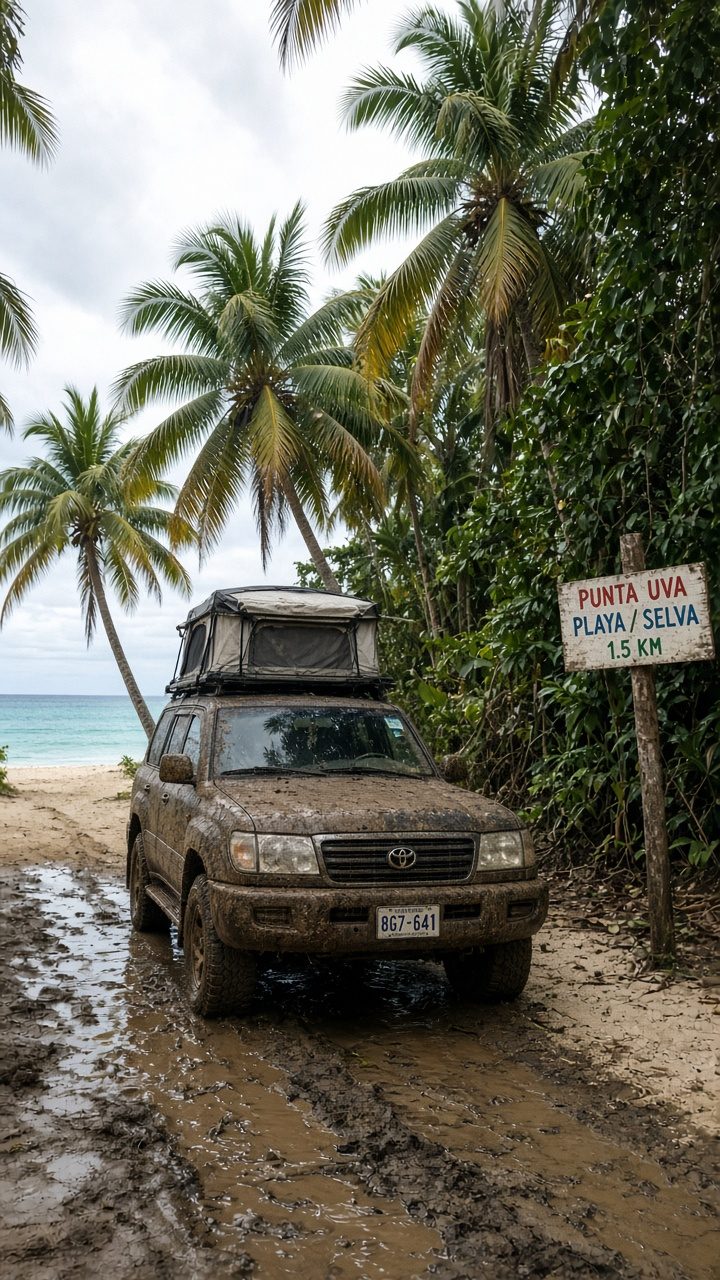
Costa Rica is one of the only countries on earth where you can watch several species of sea turtle nest on both of its coasts within a single trip — if you time it right and are willing to drive. This ambitious twelve-day tour strings together the country's marquee turtle beaches: the green-turtle canals of Tortuguero on the Caribbean, the leatherback rookery at Playa Grande on the north Pacific, the olive-ridley arribada coast at Ostional, and the south Pacific's Marino Ballena. The reward is a turtle portfolio almost no other destination can offer.
This is a 🔴 trip — not for technical roads, but for distance, transit, and the sheer logistics of chasing wildlife across two oceans. You'll cross the country twice, park the vehicle and take a boat to reach Tortuguero, and time everything against nesting windows that only loosely overlap. The Land Cruiser + rooftop tent tier gives you the range and self-sufficiency to make the long transfers and camp where lodging is thin. October–November is the sweet spot, when the Caribbean green-turtle season is winding down, leatherbacks are starting on the Pacific, and olive-ridleys are still coming ashore.
Understand the honesty of it: you are chasing several probabilities at once. Some legs will deliver; some may not, because turtles don't read calendars. Build buffer, book certified guides, and treat every nesting you witness as a gift.
Day-by-Day
Days 1–3 — Tortuguero (SJO to La Pavona ~3.5–4 hr on Rte 32 in daylight, then a ~1–1.5 hr boat; ⚠️ no road to the village). Drive Route 32 over the Braulio Carrillo pass in the morning light, park the vehicle securely at La Pavona, and take the public lancha through the canals to Tortuguero. Green turtles nest here roughly June–October (with hawksbills and some leatherbacks also on this coast). Do a canal wildlife tour by day and a licensed night turtle walk in season. Stay in Tortuguero village (no vehicles). Boat back to La Pavona on day 3.
Days 4–5 — Cross-country transit to the north Pacific (long driving, ~7–8 hr total via SJO to the Playa Grande area). A two-day repositioning across the country. Break the drive in the Central Valley or near the Gulf of Nicoya. Arrive Playa Grande and set up camp near Las Baulas.
Days 6–7 — Playa Grande / Las Baulas (paved access, short local drives). Marino Las Baulas National Park protects one of the world's most important leatherback rookeries; the nesting season runs roughly October 1 – February 28, so an early-window visit can catch the giants coming ashore. Night tours are strictly guided and permit-controlled — book through the park's authorized guides. By day, the estuary and mangroves are superb for birds and crocodiles. Camp near Playa Grande/Tamarindo.
Days 8–9 — Ostional (approx. 2.5–3.5 hr south; dirt into Nosara/Ostional, ⚠️ river-mouth crossing). Reposition to the Nosara/Ostional coast for the olive-ridley arribada, which peaks in the July–December wet season and clusters around the last-quarter-to-new-moon window. A certified guide is required, and the Ostional river mouth can be impassable at high water. Time-permitting, you'll catch a nesting event or hatchlings; either is worth the detour.
Days 10–11 — South Pacific / Marino Ballena, Uvita (long transfer, ~6–7 hr including the Paquera ferry or the inland route). The final turtle leg heads to the south-central Pacific. Uvita's Marino Ballena and nearby beaches see olive-ridley and, at some beaches, hawksbill nesting — ⚠️ verify current nesting activity and the specific beach with a local conservation project, as it's more scattered here than the marquee rookeries. Camp near Uvita. Enjoy the Whale's Tail sandbar at low tide as a bonus.
Day 12 — Return to SJO (approx. 4–4.5 hr, paved Costanera + Rte 27). The fast coastal highway and toll road back to the Central Valley and the airport or vehicle return.
Signature Stops (why go)
- Tortuguero — the green-turtle capital, reached only by boat, with canal wildlife by day and nesting by night.
- Playa Grande / Las Baulas — a globally important leatherback rookery; the biggest turtles on the planet.
- Ostional — the olive-ridley arribada coast, mass nesting like nowhere else.
- Marino Ballena / Uvita — the south Pacific finale, scattered nesting plus the iconic Whale's Tail.
Where to Camp / Stay (named)
- Tortuguero: village guesthouses and eco-cabinas (no vehicles) — the vehicle waits at La Pavona with secure parking.
- Playa Grande: campgrounds and small lodges near Las Baulas; book direct.
- Nosara/Ostional: Guiones bases or the Ostional community turtle lodge.
- Uvita: jungle and beach campgrounds near Marino Ballena.
Logistics & Road Reality
- Fuel: 🟡 plan around the transfers — fill up before the La Pavona boat, before each long cross-country leg, and in Nicoya town before Ostional.
- 4x4: 🔴 needed for the Ostional dirt/river crossing and general range; much of the highway spine is paved.
- Route 32: 🔴 daylight-only over the Braulio Carrillo pass — never at night.
- Tortuguero: 🔴 no road — park at La Pavona, boat in; last public boats run mid-afternoon.
- Season: Oct–Nov best overlaps the four windows; each species has its own timing (see below).
- Permits/guides: 🔴 certified/licensed guides required for night nesting tours at all three marquee sites.
- Connectivity: 🟢 in towns; 🔴 in Tortuguero interior, Ostional, and on the passes.
Turtle Guidance (four species, four windows, one rulebook)
Match beach to species and month:
- Green turtle — Tortuguero, Caribbean, ~Jun–Oct (peak Aug–Sep).
- Leatherback — Playa Grande/Las Baulas, Pacific, ~Oct 1–Feb 28.
- Olive-ridley — Ostional arribadas, Pacific, ~Jul–Dec, clustered near the last-quarter-to-new moon.
- Hawksbill — nests on parts of both coasts (Caribbean at Tortuguero/Gandoca; some Pacific beaches) — ⚠️ the most scattered and hardest to guarantee; verify with a local project before counting on it.
The rulebook is identical everywhere and absolute: book only licensed guides, no camera flash, no white light (red only, if permitted), never touch or crowd a turtle, and never get between hatchlings and the sea. Night tours are permit-limited by design — reserve ahead.
Insider Tips
- Anchor the trip in October–November for the best multi-species overlap.
- Reserve licensed night tours at Tortuguero, Las Baulas, and a certified Ostional guide well in advance.
- Park the vehicle at La Pavona and travel light into Tortuguero — the village has no roads.
- Drive Route 32 and the long transfers in daylight; fatigue and fog are the real hazards.
- Treat hawksbill (the fourth species) as a bonus and confirm current activity locally — it's the least predictable.
Reserve Your Rig
A Land Cruiser with a rooftop tent is what makes a two-coast turtle chase possible — the range for the cross-country transfers, the clearance for Ostional's river crossing, and a self-contained camp for the nights lodging is thin. VerifiedCR equips you with a four-species timing calendar keyed to the moon and the months, secure La Pavona parking + Tortuguero boat coordination, and vetted licensed night-tour guides at every site. Reserve your rig and build the turtle portfolio of a lifetime.
Before you go
Do you need a 4x4?
seasonal river ford — 4x4 advised
Best window to fly
Oct–Nov (best overlap of nesting windows)
Offline first
Download your route and offline maps before you leave the lot — signal drops on the best stretches.
Golden rule
Never drive at night — plan arrivals before dark, and use Waze like the locals do.
VerifiedCR · No counter surprises
What a Costa Rica rental actually costs
The number one thing that rattles first-timers is the price jumping at the counter. Here is the honest math, before you get there.
- Advertised daily rate$12–40 / day
- What the booking sites show. It is real — but it is not the whole price. Nobody pays only this.
- Mandatory liability (TPL / SLI)+$15–25 / day
- Required by Costa Rican law on every rental. Cannot be waived. This is the line the cheap ads leave off — it roughly doubles the sticker price. Budget for it.
- Collision damage (CDW)waivable
- Often $20–40/day — but you can usually decline it if your credit card includes rental coverage (Amex, Visa Signature, Chase Sapphire and others). Call your card, ask for a coverage letter, and bring it printed.
- Security hold on your card$1,000–2,500
- A hold, not a charge — released after you return the car clean. Some agencies hold more. Make sure your card has the headroom before you fly.
The verified-rig promise: when you reserve through VerifiedCR, the rig is inspection-checked and the operator is vetted — the price you are quoted is the price you pay. No mystery line items at pickup.