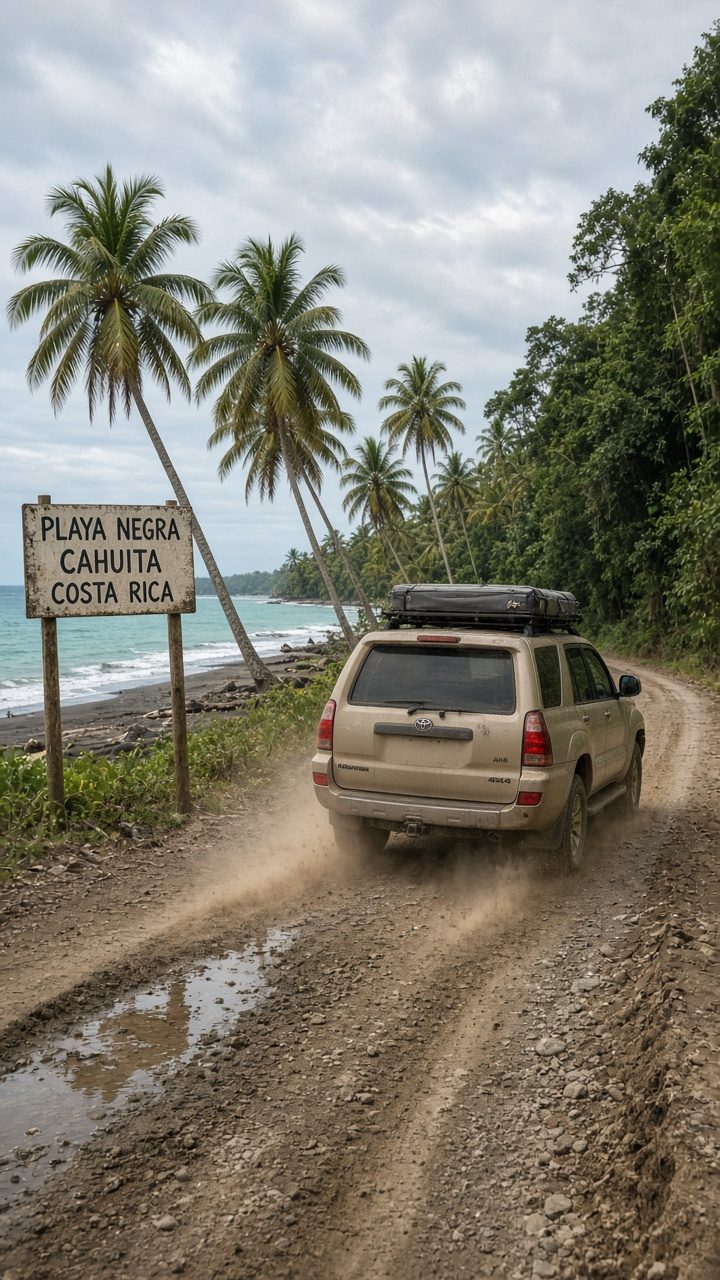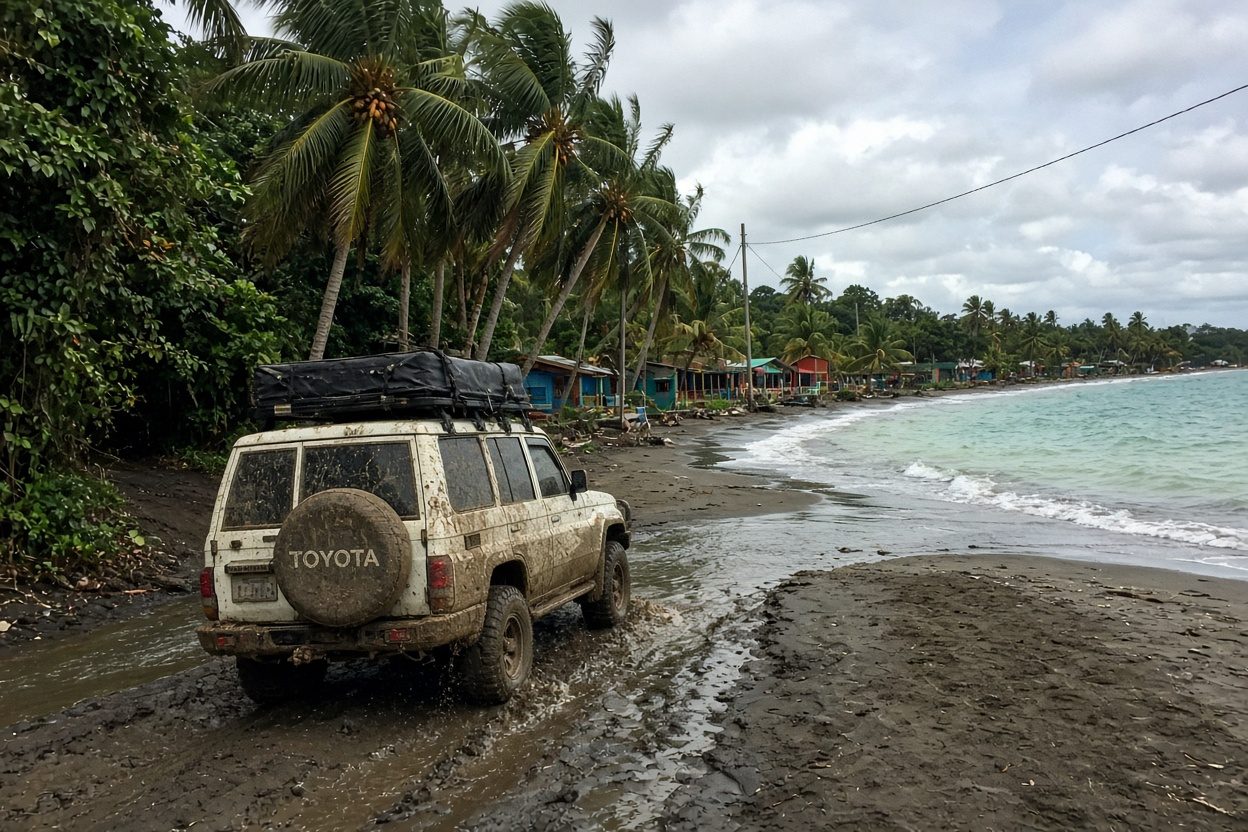
There is a narrow window each year — roughly February and March — when both of Costa Rica's coasts are good at the same time. The Pacific still has dry-season offshores and W/SW swell; the Caribbean is in the thick of its NE-trade season. This 14-day loop chases that overlap, starting in the bohemian beach-break peaks of the Nicoya Peninsula, working through the power of the Central Pacific, then crossing the country to finish on the heavy reef of the Caribbean. It is the maximum-variety surf trip: sand, points, and coral in one drive.
You'll want a Land Cruiser with a rooftop tent for this — the loop covers ferries, dirt roads, a mountain crossing, and enough distance that camping flexibility pays off. Because you finish on the far coast, ask about a one-way drop so you're not backtracking the whole country.
Day by day
Days 1–4 — Santa Teresa & Mal País (Nicoya south)
Cross on the Puntarenas–Paquera ferry and drive the dusty road down to Santa Teresa. This is the trip's warm-up and its social heart.
- Playa Carmen is a very consistent beach break that works essentially year-round, with many peaks spread along the sand — good for all levels.
- Santa Teresa proper offers punchier peaks; Mal País to the south gets hollower but has rocks that poke out at low tide, making some drops sketchy — surf it on the higher tides.
- Season: waves virtually year-round; the wet season (roughly May–August) brings the biggest, most consistent surf, but Feb–March is clean and fun.
- Eat & sleep: Santa Teresa's surf-town restaurants and beach clubs; camp or surf-camp along the strip. Fuel up — services thin out on the peninsula.
Days 5–6 — Nicoya points (Guiones / Avellanas / Playa Negra)
Work north along the peninsula. Playa Guiones (Nosara) is a dependable beach break that works on a SW-to-W swell and a rising mid-to-high tide — friendly, consistent, and great for tuning up. For a step up, the Guanacaste points beckon: Avellanas ("Little Hawaii") and the world-class hollow right-hand reef barrel at Playa Negra (Los Pargos) — the one from The Endless Summer II — best December–March on a high tide over shallow rock, with a small, sharp takeoff zone for confident surfers only.
- Roads: the last stretch into Nosara is dirt; fuel is sparse between towns.
- Eat & sleep: Nosara's healthy cafés; camp or eco-lodge.
Days 7–8 — Central Pacific: Jacó & Playa Hermosa
Ferry back and drive to the Central Pacific, the closest real surf to San José. Jacó has beginner beach break plus a party town; Playa Hermosa de Jacó is a heavy, powerful beach break that hosts pro contests — advanced water on size. Esterillos Oeste (marked by the mermaid statue at El Pico) is a quieter sand-bottom alternative just south, no reef to worry about.
- Season: year-round, bigger in the green season.
- Eat & sleep: Jacó town for amenities; camp at Esterillos for calm.
Day 9 — The crossing (Central Pacific → Caribbean)
A transit day over the central mountains and down to the Caribbean via Route 32 through Braulio Carrillo — daylight-only. Break the drive in the Central Valley or push straight through in the morning to Puerto Viejo (~5–6 hours from the coast depending on your start).
Days 10–13 — Puerto Viejo: Salsa Brava & Cocles
The grand finale on the reef.
- Salsa Brava — the Caribbean's heaviest wave, a fast, hollow right-hand reef break over sharp coral in 1–2 m. Expert only, best on E/SE + NE swell, mid-to-high tide, west wind offshore, booties required, paddle out via the channel to the right.
- Cocles — 3.5 km south, a forgiving sandy beach break for the rest of the crew or the too-big days; mind the rips and reef sections on the ends.
- Playa Negra (Caribbean) and Punta Uva for down-day mellow waves and clear swimming.
- Surf before 10 a.m. — Caribbean trades chop it up by afternoon.
- Eat & sleep: Puerto Viejo town (patí, rondón, reggae); Rockin' J's or Cocles-road guesthouses.
Day 14 — Daylight exit
Final dawn session, then Route 32 back to San José in daylight (or a one-way drop from the coast).
The breaks — why surf, and who for
| Break | Coast | Type | Skill |
|---|---|---|---|
| Playa Carmen / Santa Teresa | Nicoya | Beach break, many peaks | Beginner–advanced |
| Mal País | Nicoya | Hollow beach break (low-tide rocks) | Intermediate–advanced |
| Guiones (Nosara) | Nicoya | Beach break | Beginner–intermediate |
| Playa Negra (Los Pargos) | Guanacaste | Hollow right reef barrel | Advanced |
| Playa Hermosa (Jacó) | Central Pacific | Heavy beach break | Advanced |
| Esterillos Oeste | Central Pacific | Sand beach break | Intermediate |
| Salsa Brava | Caribbean | Hollow right reef | 🔴 Expert |
| Cocles | Caribbean | Beach break | Beginner–intermediate |
Where to stay
- Nicoya: Santa Teresa surf camps/beach clubs; Nosara eco-lodges; rooftop tent between towns.
- Central Pacific: Jacó town for amenities; Esterillos for quiet camping.
- Caribbean: Puerto Viejo town (Rockin' J's) and the Cocles road; Punta Uva for the down-day.
Surf logistics
- Season / swell window: 🟢 Feb–March is the two-coast sweet spot. Outside it, one coast is usually better than the other — the Pacific fires bigger April–October, the Caribbean Dec–March.
- Boards: Bring a quiver — a groveler/fish for Nicoya sand, an everyday shortboard, and a step-up with hold for Playa Negra and Salsa Brava. No longboards at the heavy reef.
- Hazards: 🔴 Salsa Brava's shallow coral (booties, high tide); 🔴 Cocles rips; 🔴 Mal País low-tide rocks; 🔴 Playa Negra's shallow, sharp takeoff. Two ferries and a daylight-only Route 32 crossing. Lock the rig on the Caribbean side — petty theft.
- Fuel & ferries: Fuel up before the Nicoya gaps; the Puntarenas–Paquera ferry bookends the peninsula leg — check the schedule.
- Connectivity: Good in towns, patchy on the peninsula dirt and the mountain crossing. Carry offline maps.
- Respect / localism: Salsa Brava and Playa Negra both have tight local lineups over shallow reef — earn your waves and wait your turn.
Insider tips
- Book the trip around the swell, not the calendar — Feb/March gives you the best odds of both coasts firing, but watch the forecast and flex.
- Ask for a one-way drop. Finishing on the Caribbean means you avoid re-driving the whole country.
- Do the mountain crossing in the morning. Route 32 is daylight-only and fog/rain build later in the day.
- Carry a quiver, not one board. Sand grovelers and reef step-ups are different tools; this trip needs both.
- Pace the reef finale. After ten days of Pacific sand, ease into Salsa Brava — watch a session, tape up, and pick your day.
Reserve your rig
This is a full overland loop: two ferries, a mountain crossing, dirt roads, and coast-to-coast distance. Reserve your VerifiedCR Land Cruiser with rooftop tent and board racks, ask about a one-way drop, and we'll build the swell-window briefing and ferry timing into your plan.
Before you go
Do you need a 4x4?
4x4 required
Best window to fly
February–March (both coasts favorable at once)
Offline first
Download your route and offline maps before you leave the lot — signal drops on the best stretches.
Golden rule
Never drive at night — plan arrivals before dark, and use Waze like the locals do.
VerifiedCR · No counter surprises
What a Costa Rica rental actually costs
The number one thing that rattles first-timers is the price jumping at the counter. Here is the honest math, before you get there.
- Advertised daily rate$12–40 / day
- What the booking sites show. It is real — but it is not the whole price. Nobody pays only this.
- Mandatory liability (TPL / SLI)+$15–25 / day
- Required by Costa Rican law on every rental. Cannot be waived. This is the line the cheap ads leave off — it roughly doubles the sticker price. Budget for it.
- Collision damage (CDW)waivable
- Often $20–40/day — but you can usually decline it if your credit card includes rental coverage (Amex, Visa Signature, Chase Sapphire and others). Call your card, ask for a coverage letter, and bring it printed.
- Security hold on your card$1,000–2,500
- A hold, not a charge — released after you return the car clean. Some agencies hold more. Make sure your card has the headroom before you fly.
The verified-rig promise: when you reserve through VerifiedCR, the rig is inspection-checked and the operator is vetted — the price you are quoted is the price you pay. No mystery line items at pickup.