Tortuguero is the "Amazon of Costa Rica" — a maze of freshwater canals and lagoons on the northern Caribbean coast, reachable only by boat, where green sea turtles haul out at night to nest by the hundred. There are no roads and no cars in the village. That single fact shapes the whole trip: your rented 4x4 does the hard driving to the water's edge, then waits while you slip into the slower, quieter world of the canals.
This is a friendly 🟡 route, ideal for first-time wildlife travelers. You don't need Corcovado-level fitness or permits here — canal wildlife (caimans, three species of monkey, sloths, herons, kingfishers, basilisk lizards) is easy to see from a boat, and the turtle experience is a guided evening walk on the beach. Pair it with two of the Caribbean's best-loved beach towns, Puerto Viejo and Cahuita, and you have a compact loop that delivers a lot of wildlife for the mileage.
Time it for the green-turtle season, June–November, with peak nesting July–October (hatchlings emerge roughly September–November). Outside that window the canals are still superb, but the marquee turtle event is gone.
Day-by-day
Day 1 — SJO → Guápiles / Cariari (approx. 2.5–3 hrs). Pick up the compact 4x4 and drive northeast over the Braulio Carrillo route toward Guápiles, then on to Cariari. Reckon on 2.5–3 hours to the Guápiles area, longer if the Zurquí tunnel or traffic bites. Overnight around Guápiles or Cariari so Day 2's boat is an easy morning reach (guest houses and small hotels; book ahead).
Day 2 — Drive to La Pavona, boat to Tortuguero (drive ~1–1.25 hrs from Guápiles; boat ~45–60 min). From Cariari continue on the rough final road to the La Pavona boat landing — the drive from Guápiles to La Pavona is roughly 1.25 hours, and the last stretch is exactly why you booked a 4x4. Leave the vehicle in La Pavona's secured parking (paid, attended lot at the landing) and take the lancha down the river to Tortuguero village — about 45 to 60 minutes when water levels are normal. Check into a lodge and spend the afternoon settling in and walking the village's sandy footpaths.
Day 3 — Canals + night turtle tour. Dawn canal boat tour (electric or paddle boats get closest to wildlife): expect caimans, howler and spider monkeys, sloths, and a parade of waterbirds. Midday is for the village, the turtle museum, or a beach walk (swimming is unsafe here — strong currents and sharks). After dark, the highlight: a licensed, SINAC-authorized turtle-nesting tour. Guides in radio-linked groups take you to a female already laying, on a strict no-light, no-flash protocol. Book through your lodge or a certified operator.
Day 4 — Boat out, drive to Puerto Viejo (boat ~1 hr; drive ~2.5–3 hrs). Morning lancha back to La Pavona, reclaim the rig, and drive south down the coast to Puerto Viejo de Talamanca. Afternoon free — sloth-spotting at the Jaguar Rescue Center area, beach time, or the road out to Manzanillo. Overnight in Puerto Viejo.
Day 5 — Cahuita, then return. Start with Cahuita National Park, whose flat coastal trail is one of the easiest wildlife walks in the country — sloths, howler and capuchin monkeys, coatis, and (with a guide) snakes and frogs, ending at a snorkel-able reef. Entry to the Playa Blanca sector is by donation. Then the long drive back to San José (plan a full afternoon/evening; the return over the mountains takes time).
Signature stops (why go)
- Tortuguero canals — near-guaranteed monkeys, sloths, caimans and waterbirds from a quiet boat.
- Green-turtle nesting (Jul–Oct) — one of the Caribbean's most important nesting beaches, seen up close with a certified guide.
- Cahuita National Park — flat, family-friendly wildlife trail plus reef snorkeling.
Where to camp / stay
- Tortuguero village / canals: Mawamba Lodge (beach-and-canal, walkable to the village and turtle beach), Manatus Lodge (small, comfortable, canal-side), and Evergreen Lodge (deep in the forest on a canal branch) are consistently well reviewed — all reached by boat, all book direct or through operators.
- Guápiles / Cariari: simple hotels for the pre-boat night (verify current options locally).
- Puerto Viejo: the full range from hostels to boutique eco-lodges; roof-top-tent camping is easy here.
Logistics & road reality
- 🔴 Tortuguero is not vehicle-accessible. You park at La Pavona (attended paid lot) and take the boat in; the village has no cars. Do not try to drive past the landing.
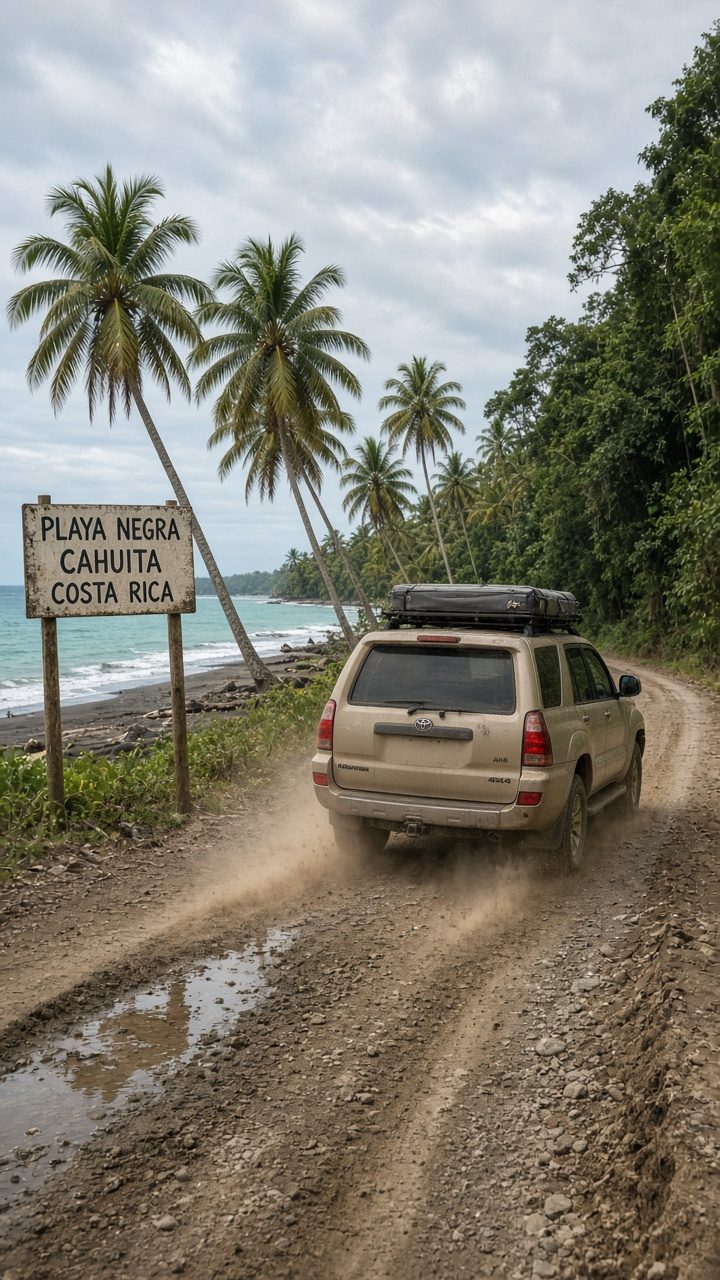
- 🟡 La Pavona final road is rough — a compact 4x4 is the right tool; low clearance struggles in the wet.
- 🔴 Turtle tours must be with a certified, SINAC-authorized guide on a strict no-light protocol. You cannot walk the nesting beach alone at night.
- 🟢 Canal tours are easy and low-intensity; morning is best.
- 🔴 No swimming at Tortuguero beach — dangerous currents and shark presence.
- Connectivity in the village is limited; sort logistics before you board the lancha.
Wildlife guidance (theme)
Season is everything for turtles: June–November, peak July–October, with hatchlings roughly September–November. Nesting happens at night; canal wildlife is best at dawn. A licensed guide matters twice over here — legally (turtle tours are guide-only and quota-managed) and ethically: the whole beach runs on darkness discipline. No flashlights, no phone screens, no flash photography near turtles; light disorients nesting females and hatchlings. Keep the group's distance and let the guide position you. Realistically you'll see nesting green turtles in season, plus monkeys, sloths, caimans, basilisks and dozens of bird species from the canals — a very high hit rate for a first wildlife trip.
Insider tips
- Pack light for Tortuguero — you're carrying bags onto a small boat; leave the bulk locked in the rig at La Pavona.
- Book the turtle tour before you arrive in peak months; nightly slots are capped.
- Bring cash and rain gear; canal mornings are wet even in "dry" spells on the Caribbean.
- A dawn canal tour beats a late one — animals are active and the light is magic.
- Confirm La Pavona parking and boat times with your lodge so the vehicle hand-off is seamless.
Reserve your rig
Tortuguero is the trip where a rented rig does the driving and the boat does the wildlife. Reserve your VerifiedCR / Carros506 compact 4x4 and we'll set up your park-at-La-Pavona service, your licensed turtle-nesting tour and a canal-boat add-on so all you carry to the water is a dry bag and binoculars. Give us your dates in turtle season and we'll handle the logistics end to end.
Before you go
Do you need a 4x4?
gravel sections — 2WD ok in dry season
Best window to fly
Jun–Nov (green turtle nesting; peak nesting Jul–Oct)
Offline first
Download your route and offline maps before you leave the lot — signal drops on the best stretches.
Golden rule
Never drive at night — plan arrivals before dark, and use Waze like the locals do.
VerifiedCR · No counter surprises
What a Costa Rica rental actually costs
The number one thing that rattles first-timers is the price jumping at the counter. Here is the honest math, before you get there.
- Advertised daily rate$12–40 / day
- What the booking sites show. It is real — but it is not the whole price. Nobody pays only this.
- Mandatory liability (TPL / SLI)+$15–25 / day
- Required by Costa Rican law on every rental. Cannot be waived. This is the line the cheap ads leave off — it roughly doubles the sticker price. Budget for it.
- Collision damage (CDW)waivable
- Often $20–40/day — but you can usually decline it if your credit card includes rental coverage (Amex, Visa Signature, Chase Sapphire and others). Call your card, ask for a coverage letter, and bring it printed.
- Security hold on your card$1,000–2,500
- A hold, not a charge — released after you return the car clean. Some agencies hold more. Make sure your card has the headroom before you fly.
The verified-rig promise: when you reserve through VerifiedCR, the rig is inspection-checked and the operator is vetted — the price you are quoted is the price you pay. No mystery line items at pickup.