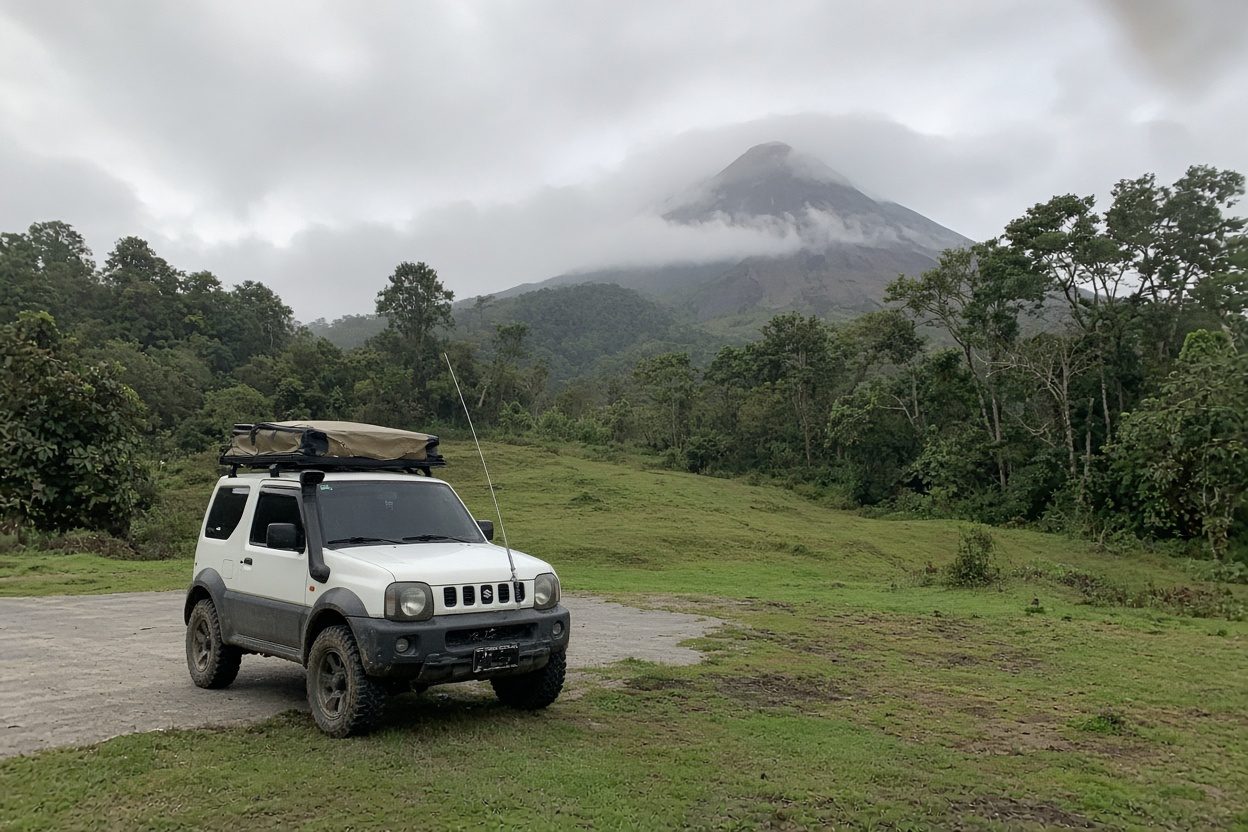
Two volcanoes, four days, no wasted time
Costa Rica sits on the Ring of Fire, and this short trip gets you to two of its most dramatic expressions back to back: Poás, whose vast, active acid crater lake steams and hisses behind a viewing terrace, and Arenal, the near-perfect cone whose 1968 eruption reshaped the region. In between, you drop through the cloud-cloaked valley of Bajos del Toro to a waterfall that plunges into an old crater. It's a geology lesson you can stand inside — active caldera, extinct crater, hardened lava field — in four efficient days.
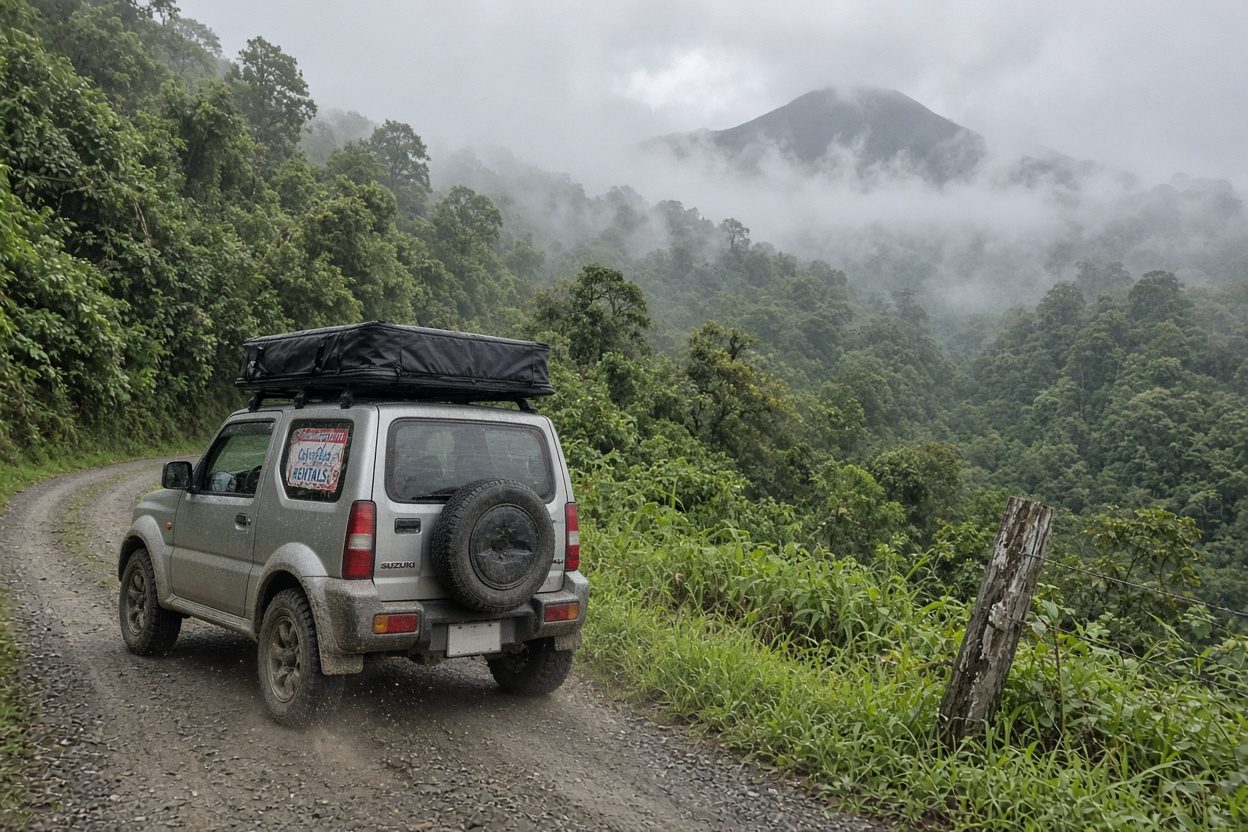
It's a 🟡 mixed trip. Poás and the Arenal icons are on paved roads, but the connector from Poás down into Bajos del Toro is a winding, foggy mountain route (paving and gravel, daylight-only), and there's a short gravel spur to camp. A compact 4x4 handles it. The one non-negotiable: Poás now requires a timed, capacity-limited SINAC ticket bought online in advance.
Why it beats the generic version: most first-timers pick one volcano. This gets you both plus a bonus crater-fall, sequenced so you're at Poás's gate at opening (the only reliable window for a clear crater) and on Arenal's lava field by day three — no backtracking, no filler.
Day by day
Day 1 — Poás crater early (drive ~1–1.5 hrs from SJO, paved 🟢). Poás Volcano National Park reopened in July 2025 with strict safety measures. You must buy a timed SINAC ticket online in advance (sinac.go.cr) — capacity is tightly capped (around 56 per slot reported), with none sold at the gate. Book the first slot: the park opens at 8am and the enormous acid crater lake is only reliably clear before mid-morning cloud and gas roll in (~$15 non-resident, verify). It's an active volcano — visits can be suspended on gas or seismic activity, so keep a flexible backup. After the crater, descend toward Bajos del Toro. Base at Rancho Los Girasoles (book via costaricacampsites.com).
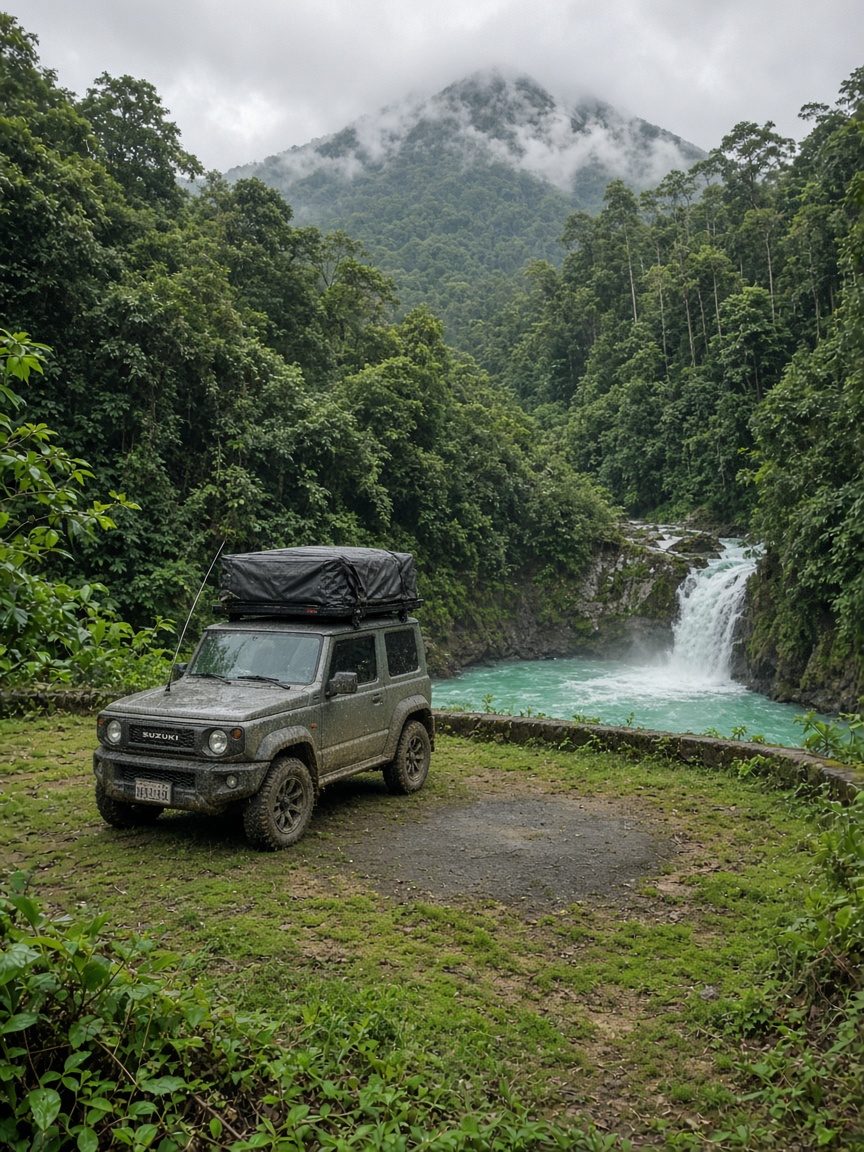
Day 2 — Catarata del Toro (short local drives, gravel spurs 🟡). In the Bajos del Toro valley, Catarata del Toro (~$14) plunges ~90 meters into an extinct crater — the perfect contrast to yesterday's active caldera. A steep ~360-step descent gets you to the base; the valley's small trout kitchens are the lunch move. If you want more, the nearby Blue Falls of Costa Rica (Las Gemelas) trailhead pairs with del Toro on a ~$25 combo ticket. Second night at Rancho Los Girasoles.
Day 3 — To Arenal, 1968 lava trail (drive ~2.5–3 hrs, 🔴 mountain then paved). Work northwest to Arenal. The signature stop is the Arenal 1968 Trail (~$27; open 8am–5pm, last entry ~3pm) — a private reserve whose well-built paths cross the hardened lava field from the 1968 eruption, with the cone looming above and a still lagoon that mirrors it on calm afternoons. (Purists can instead take the ~$15 SINAC ticket for the adjacent Arenal Volcano National Park.) Set up at Volcán Arenal Ecological Park (lakeside campground near La Fortuna; costaricacampsites.com), casado in town.
Day 4 — La Fortuna Waterfall, then out (short drive + exit). Finish with the region's icon: the La Fortuna Waterfall ($20 foreigners / $10 nationals; ~500 steps to a 70m fall; gates ~7am–4pm), a swimmable pool in a jungle box canyon. Then drive back to SJO (~3.5 hrs, paved).
Signature stops — why go
- Poás crater — one of the world's largest active acid crater lakes; a timed-permit, first-slot spectacle.
- Catarata del Toro — a ~90m fall into an extinct crater; the geological counterpoint to Poás.
- Arenal 1968 Trail — walk the actual lava field from the eruption that made Arenal famous.
- La Fortuna Waterfall — the iconic 70m jungle finale.
Where to camp / stay
- Nights 1 & 2 — Rancho Los Girasoles (Bajos del Toro). costaricacampsites.com.
- Night 3 — Volcán Arenal Ecological Park (lakeside near La Fortuna). costaricacampsites.com.
Logistics & road reality
- Roads: 🟢 paved to Poás and around the Arenal icons; 🔴 the foggy Poás→Bajos del Toro→Arenal mountain connector (paving + gravel, slow, daylight-only); 🟡 short gravel camp spurs.
- Fuel: Fill up before the mountain connector; highland fuel is sparse. Stations in La Fortuna.
- 4x4: A compact 4x4 handles the gravel spurs and wet grades.
- Season: Dec–Apr for the clearest crater mornings. Both volcanoes make their own weather — cloud caps roll in by midday, so hit craters early.
- Permits/tickets: Poás requires a timed SINAC online ticket bought in advance — book the first slot early. Other stops pay at the gate; carry cash.
- Connectivity: Good around Poás and La Fortuna; patchy on the mountain connector and in Bajos del Toro.
- Safety: Active volcano (entry can be suspended); winding foggy connector (daylight only); steep waterfall stairs.
Insider tips
- Book Poás's first slot the moment tickets open — capacity is tiny and the crater only clears in the first hour.
- Drive the Poás→Bajos del Toro connector in the morning, in daylight — it's foggy, winding and slow.
- Contrast the craters deliberately — active caldera (Poás) vs. extinct crater fall (del Toro) vs. lava field (Arenal 1968) is the whole story of the trip.
- Have a Poás backup — if gas activity closes it, Bajos del Toro and the Blue Falls fill the day.
- Gauge the crew before the waterfall stairs — 500 down means 500 up; the Arenal NP flat trails are the gentler alternative.
Reserve your rig
Two volcanoes and a crater-fall in four tight days — active caldera, extinct crater, lava field — with no backtracking and honest permit and road notes. A compact 4x4 gets you up the foggy connector and onto the lava. Reserve your 4x4 and double-crater spine now.
Before you go
Do you need a 4x4?
gravel sections — 2WD ok in dry season
Best window to fly
Dec–Apr (clearest crater mornings)
Offline first
Download your route and offline maps before you leave the lot — signal drops on the best stretches.
Golden rule
Never drive at night — plan arrivals before dark, and use Waze like the locals do.
VerifiedCR · No counter surprises
What a Costa Rica rental actually costs
The number one thing that rattles first-timers is the price jumping at the counter. Here is the honest math, before you get there.
- Advertised daily rate$12–40 / day
- What the booking sites show. It is real — but it is not the whole price. Nobody pays only this.
- Mandatory liability (TPL / SLI)+$15–25 / day
- Required by Costa Rican law on every rental. Cannot be waived. This is the line the cheap ads leave off — it roughly doubles the sticker price. Budget for it.
- Collision damage (CDW)waivable
- Often $20–40/day — but you can usually decline it if your credit card includes rental coverage (Amex, Visa Signature, Chase Sapphire and others). Call your card, ask for a coverage letter, and bring it printed.
- Security hold on your card$1,000–2,500
- A hold, not a charge — released after you return the car clean. Some agencies hold more. Make sure your card has the headroom before you fly.
The verified-rig promise: when you reserve through VerifiedCR, the rig is inspection-checked and the operator is vetted — the price you are quoted is the price you pay. No mystery line items at pickup.