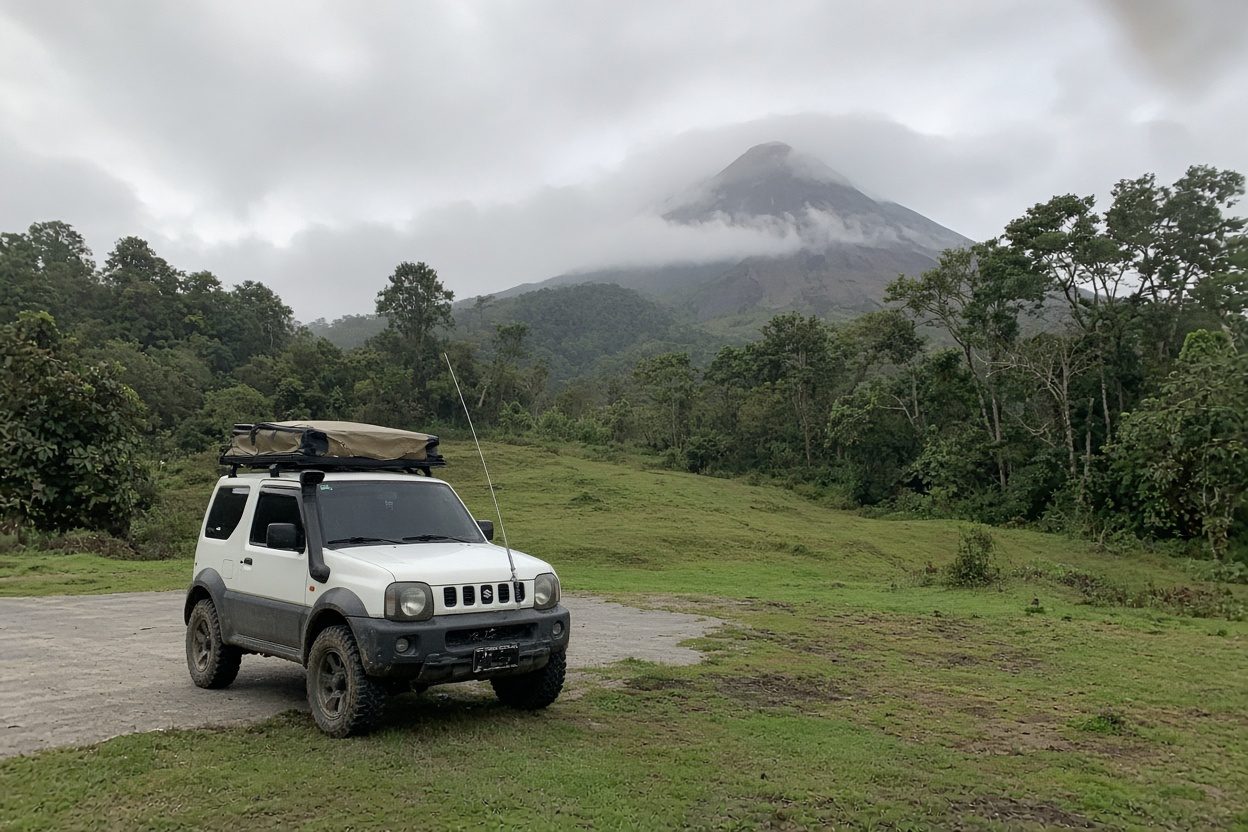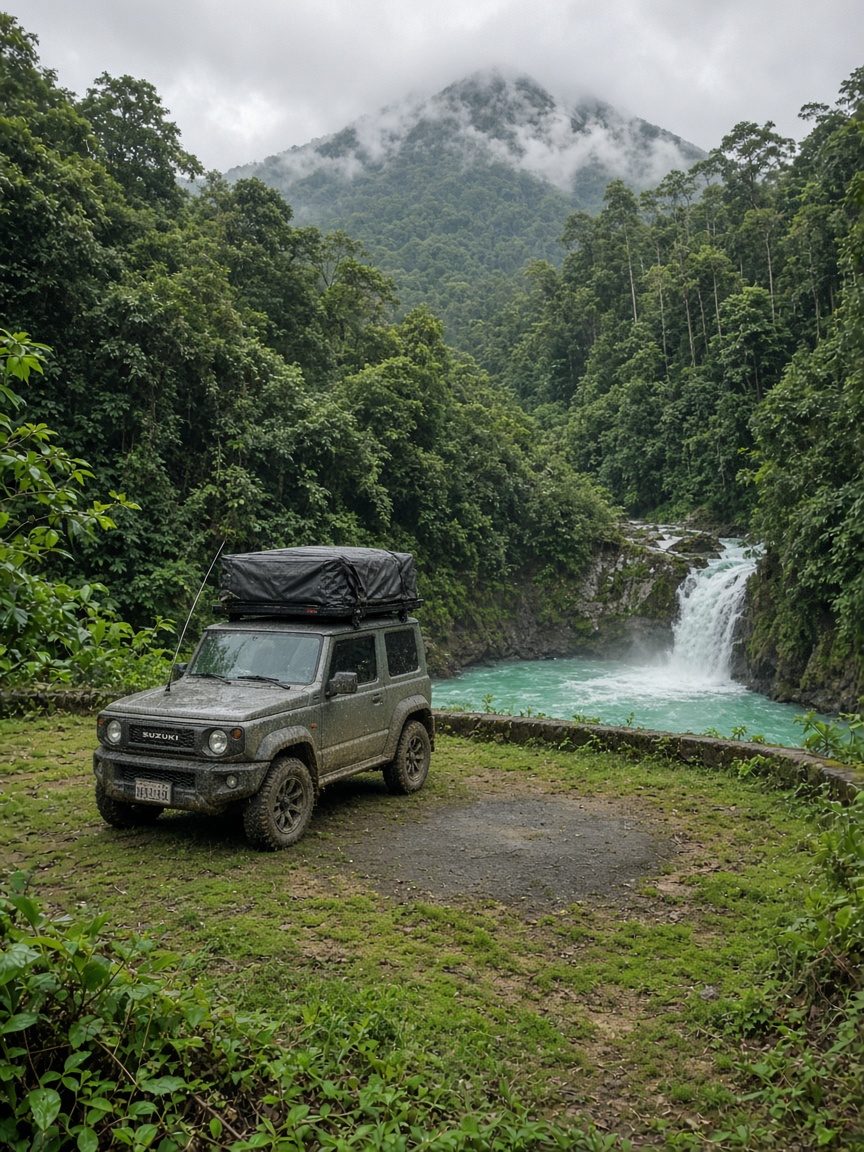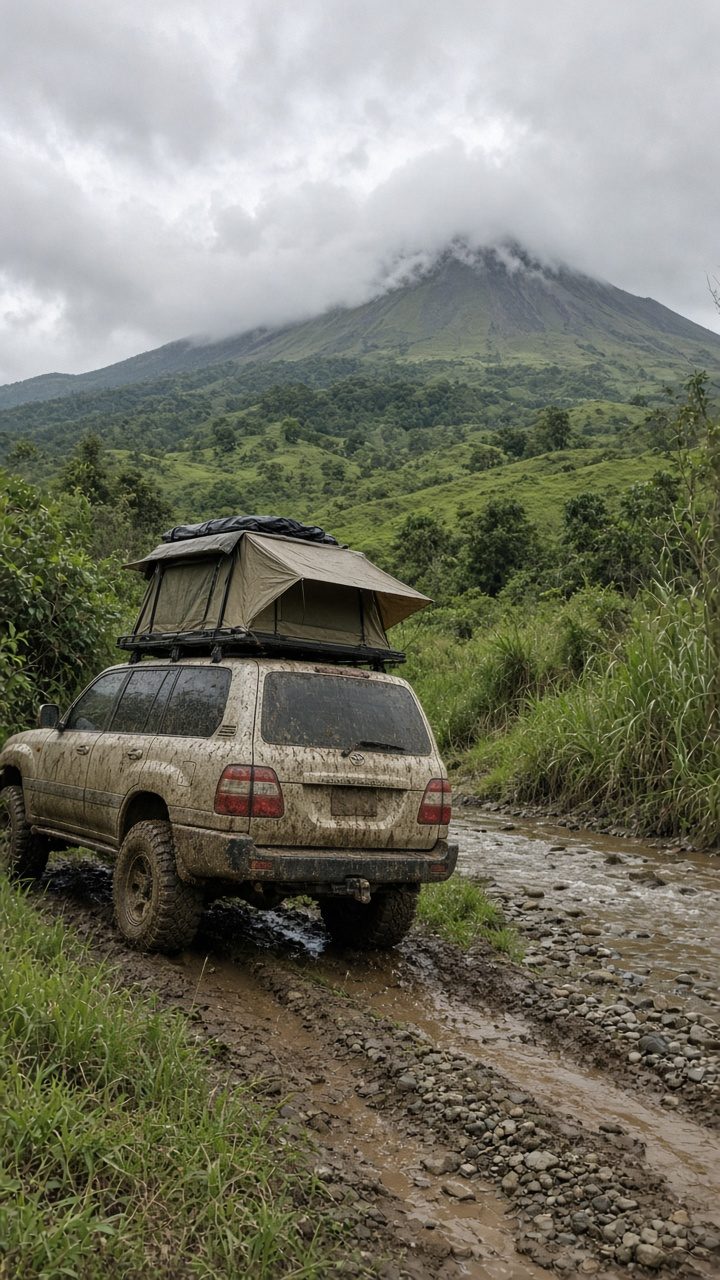
The whole core, top to tail
This is the grand tour of Costa Rica's central-northern spine — the trip that connects every marquee zone north of the capital into one continuous overland arc. In ten days you stand on the rim of an active crater, run tropical whitewater, sleep under a volcano, wade a turquoise river, watch sloths in the rain, kayak a mountain lake and cross that lake by boat into the cloud forest. It's the itinerary that leaves nothing out.
It's honestly a 🔴 through-land expedition — not because of unbridged fords, but because it strings together foggy mountain gravel connectors, a no-signal national park, two timed and capacity-limited permits, and several long repositioning drives. This is a Land Cruiser + rooftop tent trip: you want the range, clearance and self-sufficiency to rotate through six different campsites and handle wet highland grades. Dec–Apr gives the best all-round balance — clearer volcanoes and more reliable roads than green season.
Why it beats the generic version: the two-week group tour flies or shuttles between hubs and hides the country between them. Overlanding the full spine, the transitions become the trip — the mountain road down from Poás, the boat across Lake Arenal, the gravel into El Castillo at dusk — and you sleep in the landscape instead of a series of identical hotels. You also carry the honest briefing: which parks need advance tickets, which has no signal, and which connectors to drive only in daylight.
Day by day
Day 1 — Poás crater (drive ~1–1.5 hrs from SJO, paved 🟢). Poás reopened July 2025; buy a timed SINAC ticket online in advance (sinac.go.cr; capacity ~56/slot; ~$15 non-resident, verify). Take the first slot — the acid crater lake is clearest before mid-morning cloud and gas. Active volcano; entry can be suspended (have a backup). Then descend toward the lowlands. First night at a Poás-area or transit stay (verify).
Day 2 — Sarapiquí rafting + Tirimbina (drive to Sarapiquí, paved 🟢). Drop into the humid Sarapiquí lowlands. Run the Sarapiquí River (accessible Class II–III near Puerto Viejo de Sarapiquí; verify operator), then tour the Tirimbina Biological Reserve — its long river suspension bridge and hands-on chocolate/cacao tour (~$28, verify). Sarapiquí has no confirmed partner camp — base at an eco-lodge such as Selva Verde or the Tirimbina lodge (verify).
Day 3 — To Arenal, La Fortuna Waterfall (drive ~1.5–2 hrs, paved 🟢). West to Arenal. Hit the La Fortuna Waterfall ($20 foreigners / $10 nationals; ~500 steps; gates 7am–4pm). Casado in town at Soda Viquez. Set up at Camping y Mirador El Castillo ($8–10/person; rough gravel access; best volcano view). costaricacampsites.com.
Day 4 — Hanging bridges + Tabacón (short paved drives 🟢). Morning at the Mistico Arenal Hanging Bridges (self-guided ~$38, verify), then an afternoon/evening soak at Tabacón Hot Springs (day pass ~US$50 up to ~$90–125 with meals; reserve ahead, verify). Second night at El Castillo.
Day 5 — Río Celeste / Tenorio NP (drive ~2 hrs to Bijagua then gravel spur; 🔴 no signal). GPS "Parque Nacional Volcán Tenorio," not "Río Celeste." Buy the SINAC ticket online in advance (non-resident $12; entry 8am–2pm); no cell signal at the park — download everything first. Walk to the celeste lagoon and the teñideros. Waterfall-base stairs partially closed since a mid-2025 landslide (fall visible from upper platform; ~250 steep stairs; verify). Flag: possible full closure ~March 2026 — check sinac.go.cr. Overnight at La Aurora (Bijagua side). costaricacampsites.com.
Day 6 — Bijagua sloth tour (short drives, paved + gravel 🟢). Slow the pace with a Bijagua community sloth tour — the area's small family-run reserves are among the best places in the country to reliably see two- and three-toed sloths (verify operator). A gentle, rain-friendly wildlife day. Second night at La Aurora.
Day 7 — Lakeside + Viento Fresco / Manakin (drive ~2–2.5 hrs to Lake Arenal, paved 🟢). Work south to Lake Arenal's Tilarán side. Fall-hop the affordable, swimmable Viento Fresco Waterfalls (~$18, verify) and nearby Catarata Manakin. Camp lakeside at La Tronadora, with kayak/SUP access (rent locally; verify). costaricacampsites.com.
Day 8 — Jeep-Boat-Jeep to Monteverde (🟡 transfer, ~3 hrs total). Cross Lake Arenal on the Jeep-Boat-Jeep (shared ~$40–45/person; ~30-min boat; confirm your rig's route around the lake with the operator in advance — verify). Arrive Santa Elena and check into the Higuerón rooftop-tent site. costaricacampsites.com.
Day 9 — Cloud forest + Selvatura (short mountain drives 🟡). Dawn walk in Curi-Cancha Reserve ($18–20, verify) for quetzals and quiet, then the canopy at Selvatura Park — $49 + 13% tax). Final cloud-forest night at Higuerón.13-line zipline ($50, verify) and/or the hanging-bridge walk (
Day 10 — Out. Descend the winding Santa Elena road in daylight (allow extra time) and drive to your exit (SJO or LIR).
Signature stops — why go
- Poás crater — an active, vast acid crater lake; a timed-permit, first-slot shot.
- Sarapiquí rafting + Tirimbina chocolate — whitewater and cacao in the humid lowlands.
- La Fortuna Waterfall & Tabacón — the Arenal icons: a 70m fall and a natural thermal river.
- Río Celeste (Tenorio) — the country's most famous turquoise water.
- Bijagua sloth tour — the most reliable sloth-spotting in Costa Rica.
- Jeep-Boat-Jeep + Monteverde — a scenic lake crossing into cloud-forest quetzals and mega-ziplines.
Where to camp / stay
- Night 1 — Poás-area/transit stay (verify).
- Night 2 — Sarapiquí eco-lodge (Selva Verde / Tirimbina; no confirmed partner camp; verify).
- Nights 3 & 4 — Camping y Mirador El Castillo (~$8–10/person; rough gravel; best volcano view). costaricacampsites.com.
- Nights 5 & 6 — La Aurora (Bijagua / Río Celeste side). costaricacampsites.com.
- Night 7 — La Tronadora (lakeside, Tilarán; kayak/SUP). costaricacampsites.com.
- Nights 8 & 9 — Higuerón rooftop-tent site (Monteverde side). costaricacampsites.com.
Logistics & road reality
- Roads: 🔴 the reposition and mountain connectors (Poás lowlands, Bijagua, and the general long-transfer days) and the no-signal Tenorio spur; 🟡 gravel at El Castillo and the Santa Elena climb; 🟢 paved on most of the spine. The Jeep-Boat-Jeep replaces the slow lake drive-around.
- Fuel: Fill up before every mountain connector and in Bijagua and Tilarán; range matters on this loop — one reason for the Land Cruiser.
- 4x4: A Land Cruiser earns its keep here — gravel camp roads, wet grades, and the self-sufficiency to rotate six camps.
- Season: Dec–Apr is the best all-round window (clearer craters, more reliable roads). Green season gives fuller falls but slicker connectors and afternoon downpours.
- Permits/tickets: Poás and Río Celeste both require SINAC online tickets in advance (timed, capacity-limited; no signal at Tenorio). Book rafting and the Jeep-Boat-Jeep ahead; confirm rig logistics for the crossing.
- Connectivity: Zero signal at Río Celeste/Tenorio; patchy in the highlands and on the lake. Plan offline.
- Safety: Drive foggy mountain connectors and the Santa Elena road in daylight only. Active volcanoes can suspend entry — carry a backup plan. Steep, wet trails throughout.
Insider tips
- Book Poás's first slot and the Tenorio ticket the moment they open — both are capacity-limited, and Tenorio has no signal to fix anything at the gate.
- Pace it as three blocks — highlands (Poás/Sarapiquí), Arenal/Tenorio, then Lake Arenal/Monteverde — with the Bijagua sloth day and the lake crossing as built-in rest.
- Drive the mountain connectors before the afternoon rain and always in daylight.
- Confirm your rig's route around the lake for the Jeep-Boat-Jeep before you commit to the crossing.
- Carry cash in small bills — nearly every gate, camp and family reserve on the spine is cash-first.
Reserve your rig
Ten days, six camps, every marquee zone of the central-northern spine — crater to whitewater to volcano to turquoise river to cloud forest, with the transitions as the highlight. A Land Cruiser with a rooftop tent gives you the range and self-sufficiency to do it right, and the honest briefing keeps the permits and no-signal park from tripping you up. Reserve your expedition rig and the full-spine camp rotation now.
Before you go
Do you need a 4x4?
4x4 required
Best window to fly
Dec–Apr (best all-round balance of clear volcanoes and open roads)
Offline first
Download your route and offline maps before you leave the lot — signal drops on the best stretches.
Golden rule
Never drive at night — plan arrivals before dark, and use Waze like the locals do.
VerifiedCR · No counter surprises
What a Costa Rica rental actually costs
The number one thing that rattles first-timers is the price jumping at the counter. Here is the honest math, before you get there.
- Advertised daily rate$12–40 / day
- What the booking sites show. It is real — but it is not the whole price. Nobody pays only this.
- Mandatory liability (TPL / SLI)+$15–25 / day
- Required by Costa Rican law on every rental. Cannot be waived. This is the line the cheap ads leave off — it roughly doubles the sticker price. Budget for it.
- Collision damage (CDW)waivable
- Often $20–40/day — but you can usually decline it if your credit card includes rental coverage (Amex, Visa Signature, Chase Sapphire and others). Call your card, ask for a coverage letter, and bring it printed.
- Security hold on your card$1,000–2,500
- A hold, not a charge — released after you return the car clean. Some agencies hold more. Make sure your card has the headroom before you fly.
The verified-rig promise: when you reserve through VerifiedCR, the rig is inspection-checked and the operator is vetted — the price you are quoted is the price you pay. No mystery line items at pickup.