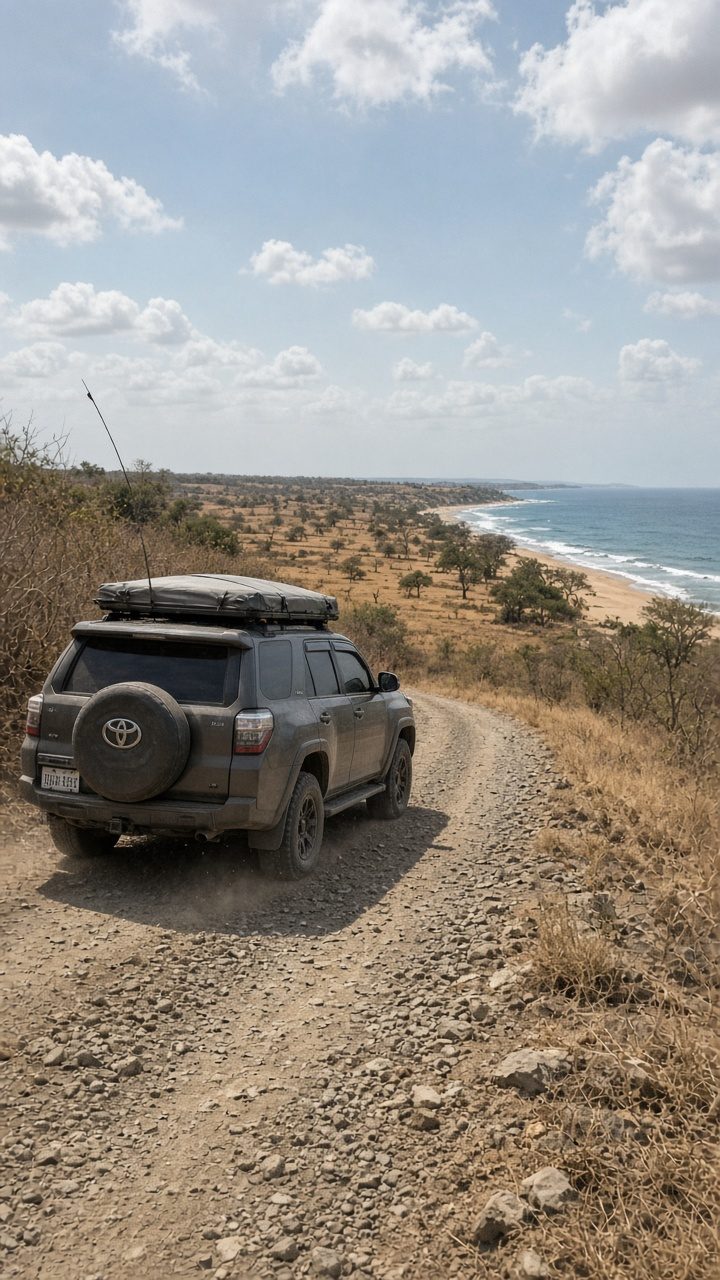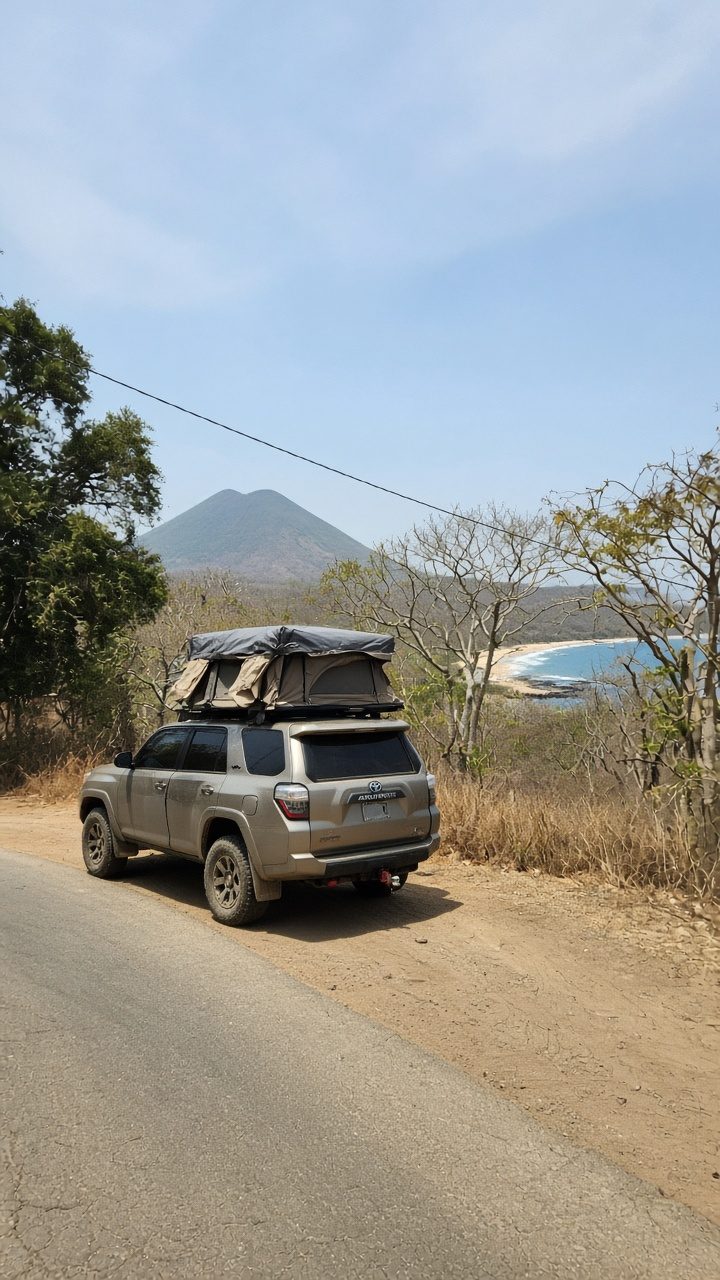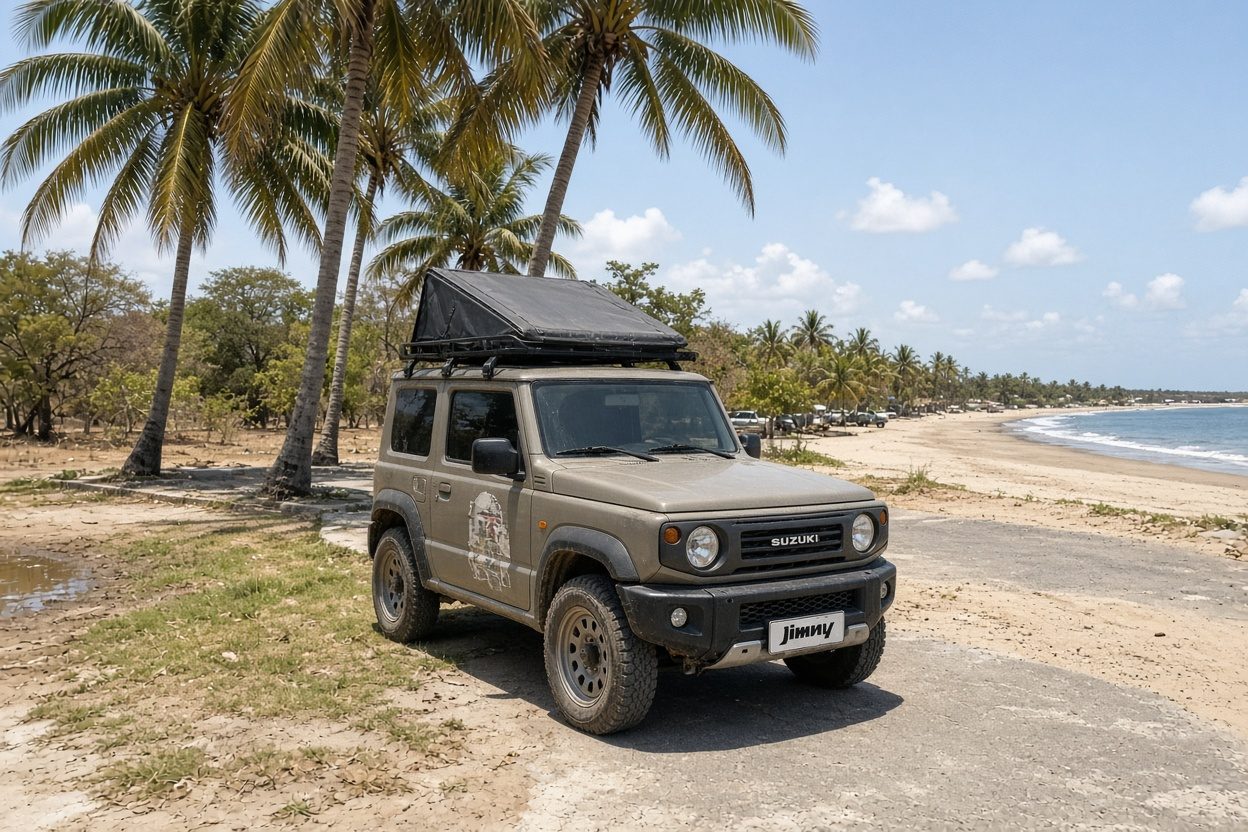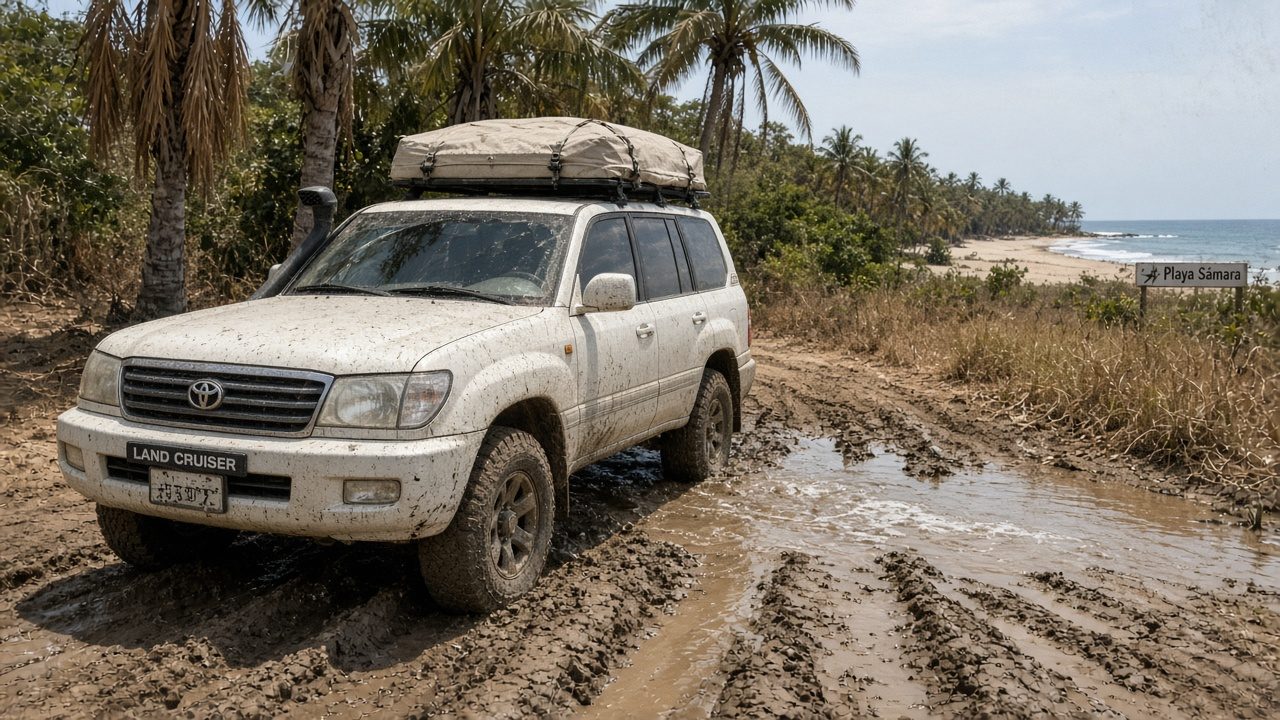
The Nicoya Peninsula is a string of world-class beach breaks separated by exactly the kind of terrain that keeps them uncrowded: washboard dirt, fuel deserts, and a coastline you cannot drive straight down. That's the point. This eight-day run chains Tamarindo, Playa Grande, Nosara/Guiones, Sámara/Carrillo, and Santa Teresa/Mal País into one southbound line, sleeping in a rooftop tent and hunting the dawn tide down the peninsula.
This is a 🔴 through-land trip, not a resort loop. You cannot hug the coast the whole way — the "shortcut" beach tracks cross rivers that will end your trip — so the route runs coast-to-inland-to-coast, and the grand finale is a ferry across the Gulf of Nicoya to reach Santa Teresa. It's for surfers who are comfortable with self-supported travel, who read tide and swell charts for fun, and who understand that the reward for the hard bits is a lineup with a fraction of the crowd.
The rig is a Land Cruiser with rooftop tent for a reason: ground clearance for the dirt, board space, and the freedom to sleep near the break instead of chasing a bed. Do this in the dry season (Dec–Apr) for the friendliest roads; the surf itself works year-round, with swell often bigger in the green months.
Day by Day
Day 1 — Liberia (LIR) → Tamarindo / Playa Grande (~75 km, ~1h15, paved). Collect the Cruiser, rack the boards, and drive to the Tamarindo area. Warm up at Tamarindo's long, forgiving beach break or paddle across the estuary to the sandbar. If you're a stronger surfer, Playa Grande next door is the more powerful, less crowded option (note it's a protected turtle beach — no night access in nesting season). Sleep at a Playa Grande surf hotel like the Rip Jack Inn, or pitch the tent at an established site.
Day 2 — → Nosara / Playa Guiones (~95 km, ~2h30, paved then dirt). Fuel up fully in Tamarindo/Villarreal — the Nosara–Tamarindo fuel gap is real. The final hour into Nosara is dirt washboard; take it slow. Playa Guiones is the peninsula's most consistent beginner-to-intermediate beach break, sand-bottomed and forgiving, working on most tides. Base in the Guiones area.
Day 3 — Nosara / Guiones surf day. Dawn patrol Guiones, rest through the midday onshore, and surf again on the evening glass-off. Guiones handles a wide range of skill; the north end and river-mouth peaks reward exploration. Eat in the Guiones strip; sleep another night to bank two clean sessions.
Day 4 — Nosara → Sámara (~35 km, ~1h, mixed). Drop south to Playa Sámara, a calm, reef-protected bay — a gentle break and a good down-day or longboard cruiser. Better waves sit just south. Sámara has real beachfront eats: El Lagarto (grill), Mr. Pelícano and El Arclán are local favorites. Camp or stay near the bay.
Day 5 — Sámara → Carrillo / Barrigona (~10–20 km, mixed). Playa Carrillo is the palm-lined, postcard bay just south — quiet, no development on the sand. Barrigona (a rougher access) is the hidden gem for a session away from everyone. Provision and fuel up in Sámara now — the Sámara–Santa Teresa stretch is the second big fuel gap and there's little between here and the ferry.
Day 6 — Sámara → Santa Teresa via Paquera ferry (long transfer day). This is the logistics day. You cannot reliably drive the coast south from Carrillo — you route inland toward Puntarenas, then take the Puntarenas → Paquera ferry (~70 min crossing, 8 daily departures, car ~$23 + ~$1.50/person, cash at the dock or book online via QuickPay; arrive 45–90 min early). From Paquera it's a rough, dusty ~1.5h to Santa Teresa. Alternatively route down the peninsula's interior — verify current road conditions locally. Sleep in Santa Teresa/Mal País.
Day 7 — Santa Teresa / Mal País surf. The finale. Santa Teresa delivers powerful, punchy beach-break peaks up and down a long stretch — Playa Carmen in the center, quieter peaks toward Playa Hermosa (north) and Mal País (south). Dawn and dusk are best before the wind. Stay at Mal Pais Surf Camp (surf-focused, on-site restaurant/bar) or a Santa Teresa boutique like Tropico Latino.
Day 8 — Santa Teresa → Paquera ferry → Liberia (LIR) (long day). Reverse the ferry (book the return in advance) and drive back up to Liberia. Give yourself a generous buffer — the ferry plus the Paquera road plus the drive north is a full travel day.
Signature Stops
- Playa Grande — powerful, uncrowded beach break beside Tamarindo, protected as a turtle sanctuary.
- Playa Guiones (Nosara) — the peninsula's most reliable all-tide sand break; the safest bet for a guaranteed session.
- Playa Carrillo — a flawless palm-fringed crescent for a mellow longboard day between the heavier breaks.
- Santa Teresa / Mal País — long, punchy beach break with peaks for every level; the trip's crescendo.
Where to Camp / Stay
- Playa Grande: Rip Jack Inn or established campsites.
- Nosara/Guiones: Olas Verdes, The Gilded Iguana, or rooftop-tent sites near Guiones.
- Sámara/Carrillo: beachfront cabinas or tent sites around the bay.
- Santa Teresa/Mal País: Mal Pais Surf Camp or Tropico Latino.
Logistics & Road Reality
- Two fuel gaps — the whole trip's crux: fill up before Nosara–Tamarindo and before Sámara–Santa Teresa. Do not push your luck; gas stations are sparse and hours are irregular.
- Ferry: Puntarenas → Paquera, ~70 min, 8 daily sailings (4:00, 6:30, 9:00, 12:00, 3:00, 6:00, 8:00, 10:00). Car
₡11,400 ($23) + ~₡810/adult, plus 13% VAT; cash at the dock (no $50/$100 bills) or pre-book online — book both directions. Paquera has poor signal, so save your ticket offline. - Roads: Paved 🟢 spine, but multiple dirt washboard 🔴 stretches (Nosara approach, Barrigona, the Paquera road). Never take coastal river-crossing shortcuts — they strand vehicles.
- 4x4: Land Cruiser strongly recommended; you'll use the clearance daily.
- Season: Dec–Apr for the easiest roads; surf runs year-round with bigger green-season swell.
- Connectivity: Patchy on all dirt sections and near Paquera. Download offline maps and surf forecasts.
- Safety: Lock boards and valuables; break-ins happen at popular lineups. Respect local priority in the water.
Insider Tips
- Treat fuel like a surf variable: top off at every station you pass south of Tamarindo, even at half a tank.
- Book the ferry both ways online before Day 6 — a missed sailing can cost you hours.
- Guiones is your insurance session: if the swell is flat or blown out everywhere else, it almost always has something rideable.
- Surf Santa Teresa at first light — by mid-morning the onshore wind turns the beach break to mush.
- Carry a spare leash, fin key, and wax for warm water; the peninsula's surf shops are scattered and often closed by dusk.
Reserve Your Rig
This is a Land Cruiser + rooftop tent trip — clearance for the dirt, room for the quiver, and a bed wherever the tide is best. Add board racks, the ferry-concierge service (we pre-book both crossings), and the offline route + surf-forecast pack so the only thing you're chasing is the next set.
Before you go
Do you need a 4x4?
4x4 required
Best window to fly
Dec–Apr (surf year-round)
Offline first
Download your route and offline maps before you leave the lot — signal drops on the best stretches.
Golden rule
Never drive at night — plan arrivals before dark, and use Waze like the locals do.
VerifiedCR · No counter surprises
What a Costa Rica rental actually costs
The number one thing that rattles first-timers is the price jumping at the counter. Here is the honest math, before you get there.
- Advertised daily rate$12–40 / day
- What the booking sites show. It is real — but it is not the whole price. Nobody pays only this.
- Mandatory liability (TPL / SLI)+$15–25 / day
- Required by Costa Rican law on every rental. Cannot be waived. This is the line the cheap ads leave off — it roughly doubles the sticker price. Budget for it.
- Collision damage (CDW)waivable
- Often $20–40/day — but you can usually decline it if your credit card includes rental coverage (Amex, Visa Signature, Chase Sapphire and others). Call your card, ask for a coverage letter, and bring it printed.
- Security hold on your card$1,000–2,500
- A hold, not a charge — released after you return the car clean. Some agencies hold more. Make sure your card has the headroom before you fly.
The verified-rig promise: when you reserve through VerifiedCR, the rig is inspection-checked and the operator is vetted — the price you are quoted is the price you pay. No mystery line items at pickup.